West End's New Gate: The 3D Render vs. the Job Site
Good news for West End: the Alcaldía de Roatán (the town hall) is building a welcome gate at the entrance to the village. A real one, with a roof, a guard booth and a “Welcome to West End” sign. It’s part of a set of renders the municipality published under its motto, Roatán Avanza (“Roatán moves forward”).
First, the project, reported straight, like news. Then I put on my electrician’s hard hat, look at the job site, and have a small breakdown. You’ve been warned.
What the Alcaldía is building: the renders
Three 3D images signed “Diseño: Arq. Jorge Aníbal Meza”, with the Alcaldía de Roatán logo:
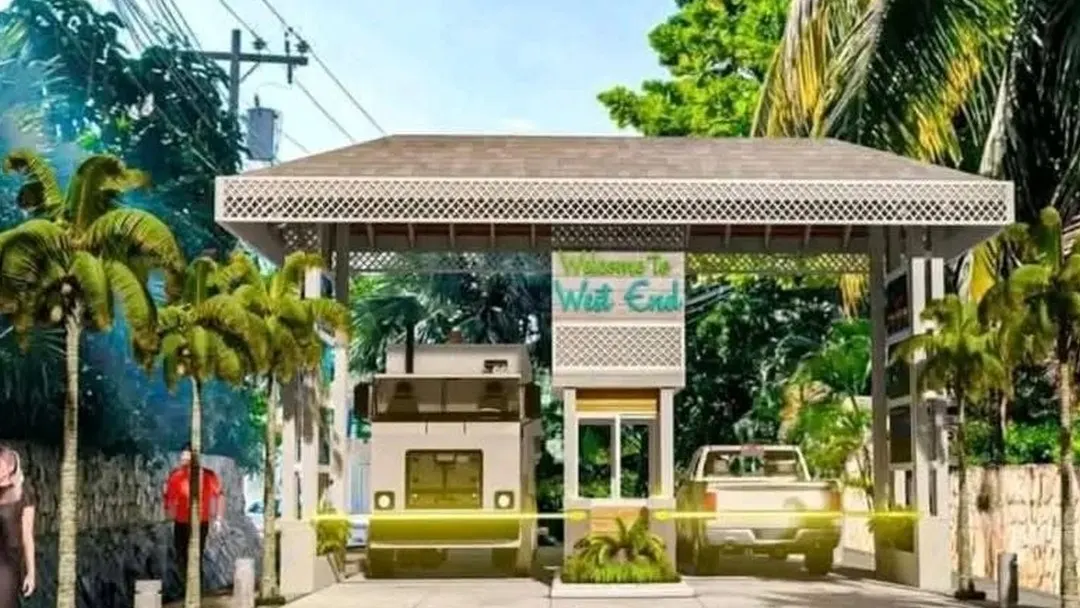
- The gate. A hip roof with a white lattice frieze, white columns, a guard booth in the middle, two yellow boom barriers and a “Welcome to West End” sign. Palm trees line both sides of the road, bollards protect pedestrians, and a big terracotta circle decorates the pavers.
- The boardwalk. A wooden walkway along the water, with a white X-pattern railing and street lamps. The water taxis wait right beside it.
- The letters. Big colorful WEST END ROATÁN letters on the boardwalk, ready for your selfies.
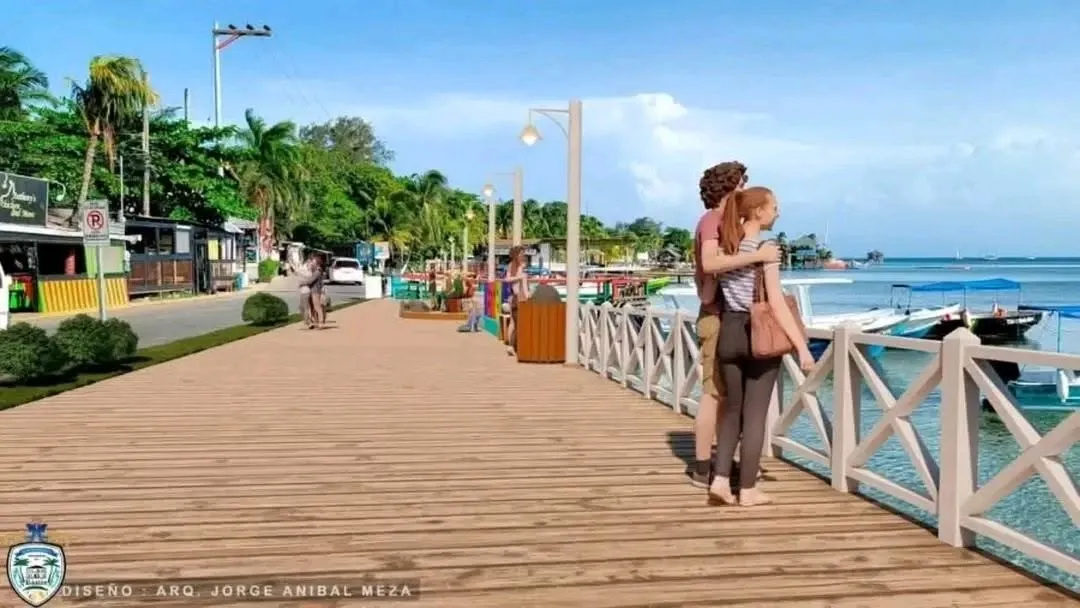
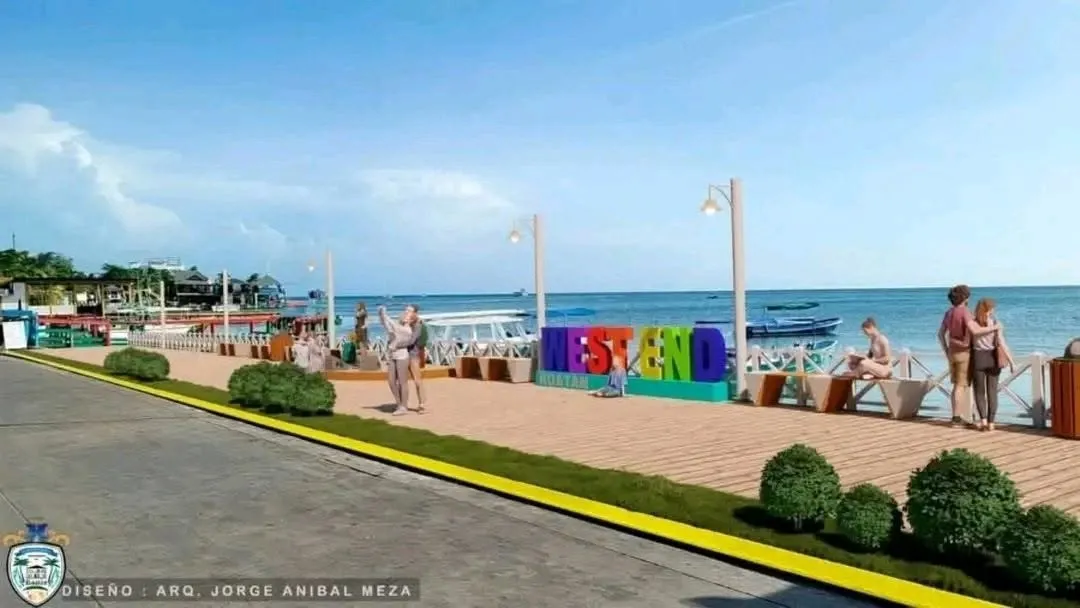
Renders: Alcaldía de Roatán, design by Arq. Jorge Aníbal Meza.
For a village that welcomes divers and cruise guests every day, that’s a great front door. West End deserves it. Now let’s go look at the job site.
Spot the difference: render vs. reality
The slider at the top of the page lays one image over the other. Here’s the breakdown:
| The render | Reality | |
|---|---|---|
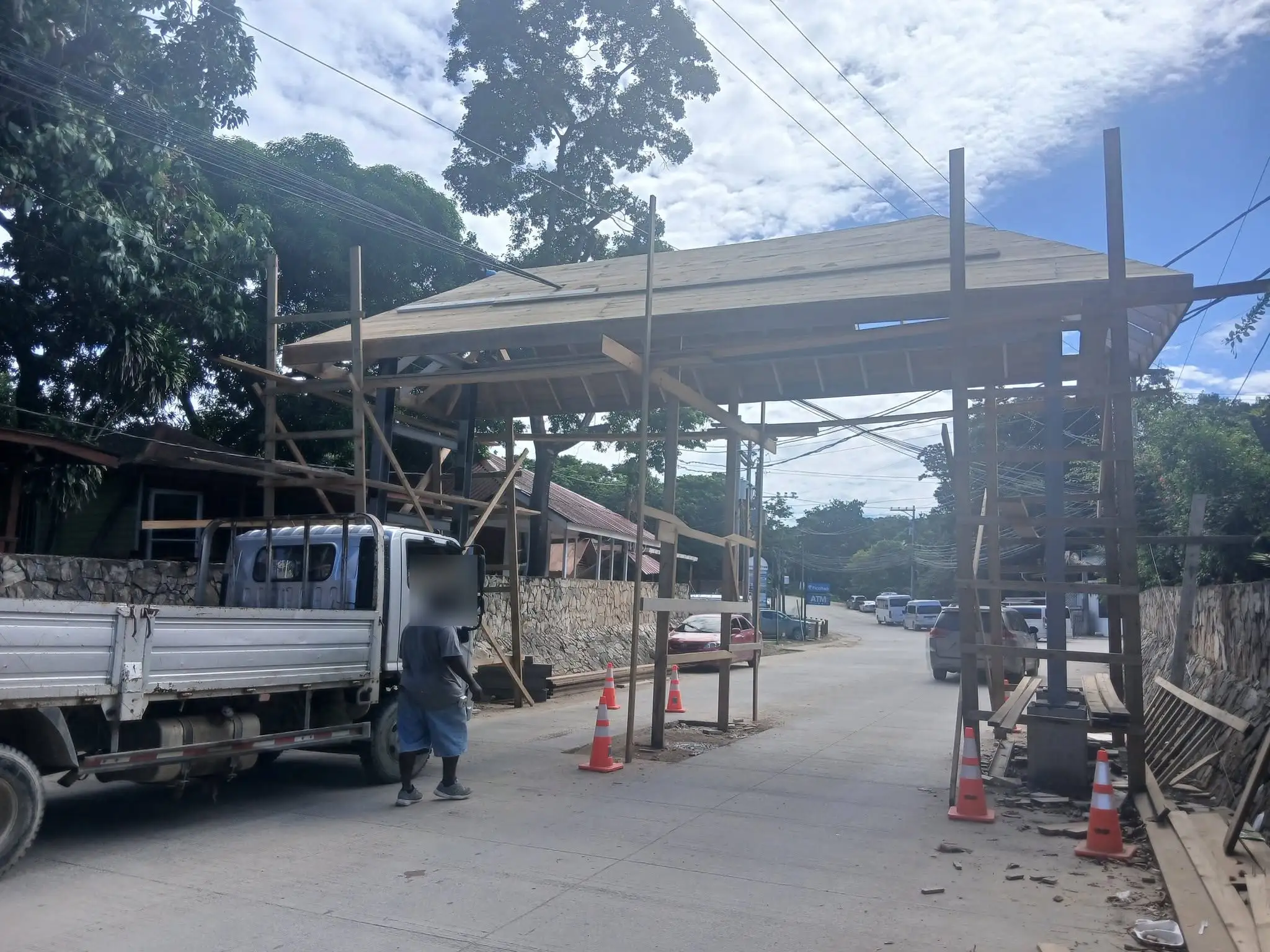
| Roof | Hip roof, shingles, white lattice | Hip roof in bare plywood. The shape is right, well done |
| Columns | White, finished | Dark steel tubes on concrete footings |
| Power lines | None. Zero. Paradise | About ten, including a bundle that runs through the roof |
| Palm trees | About ten | None |
| Booth and barriers | Center, brand new | A square of dirt surrounded by cones |
| Road | Pavers and a terracotta circle | Concrete |
| Pedestrians | Smiling couples | One worker walking in the lane, in shorts and sneakers |
| Vehicles | A truck driving through the barrier | A truck parked in the lane, cars driving under the roof |
The render forgot one detail: in Roatán, power lines are part of the scenery. Architects always erase them. Reality never does.
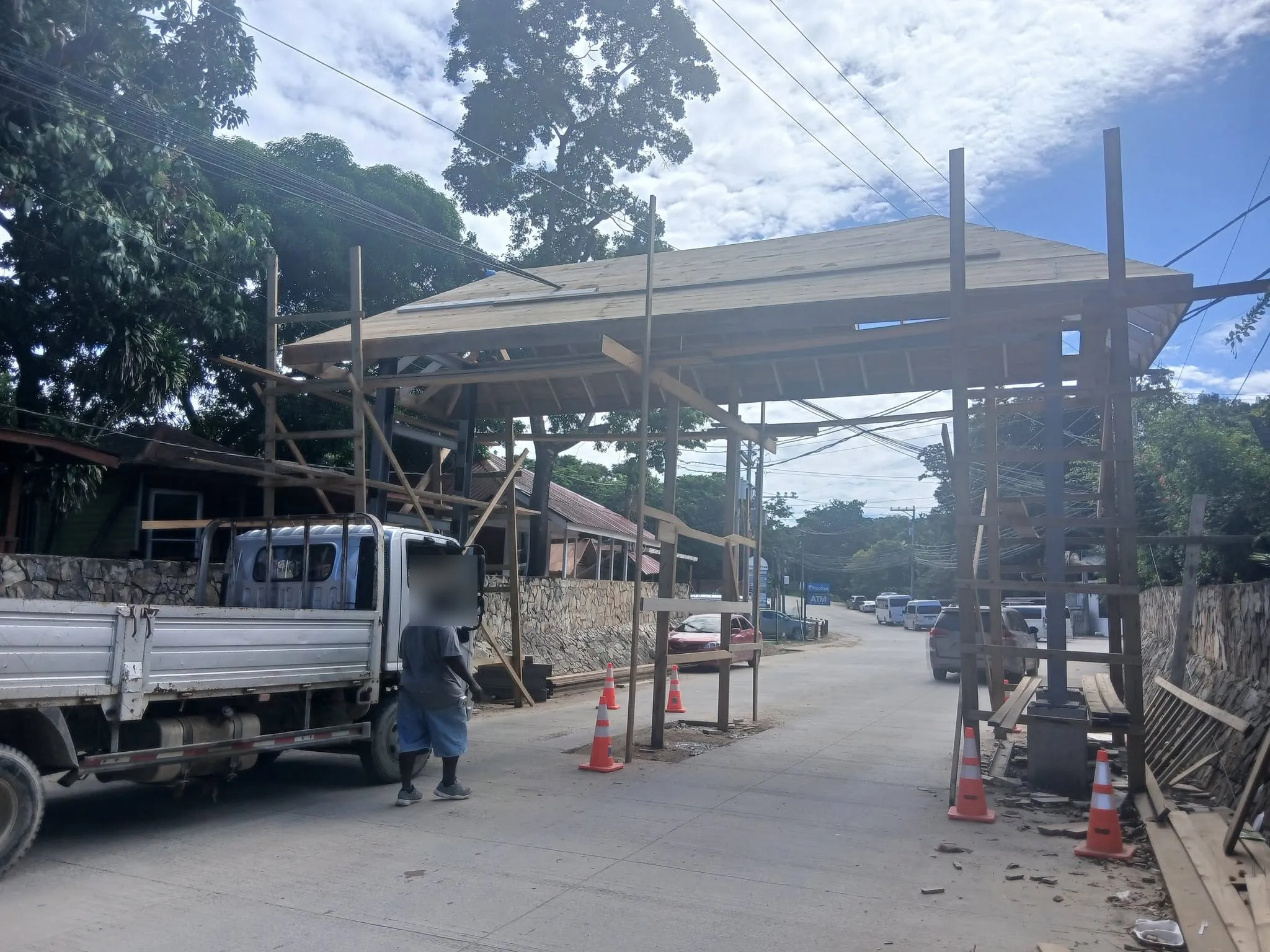
The wires that go THROUGH the roof
Look at this photo. Take your time.
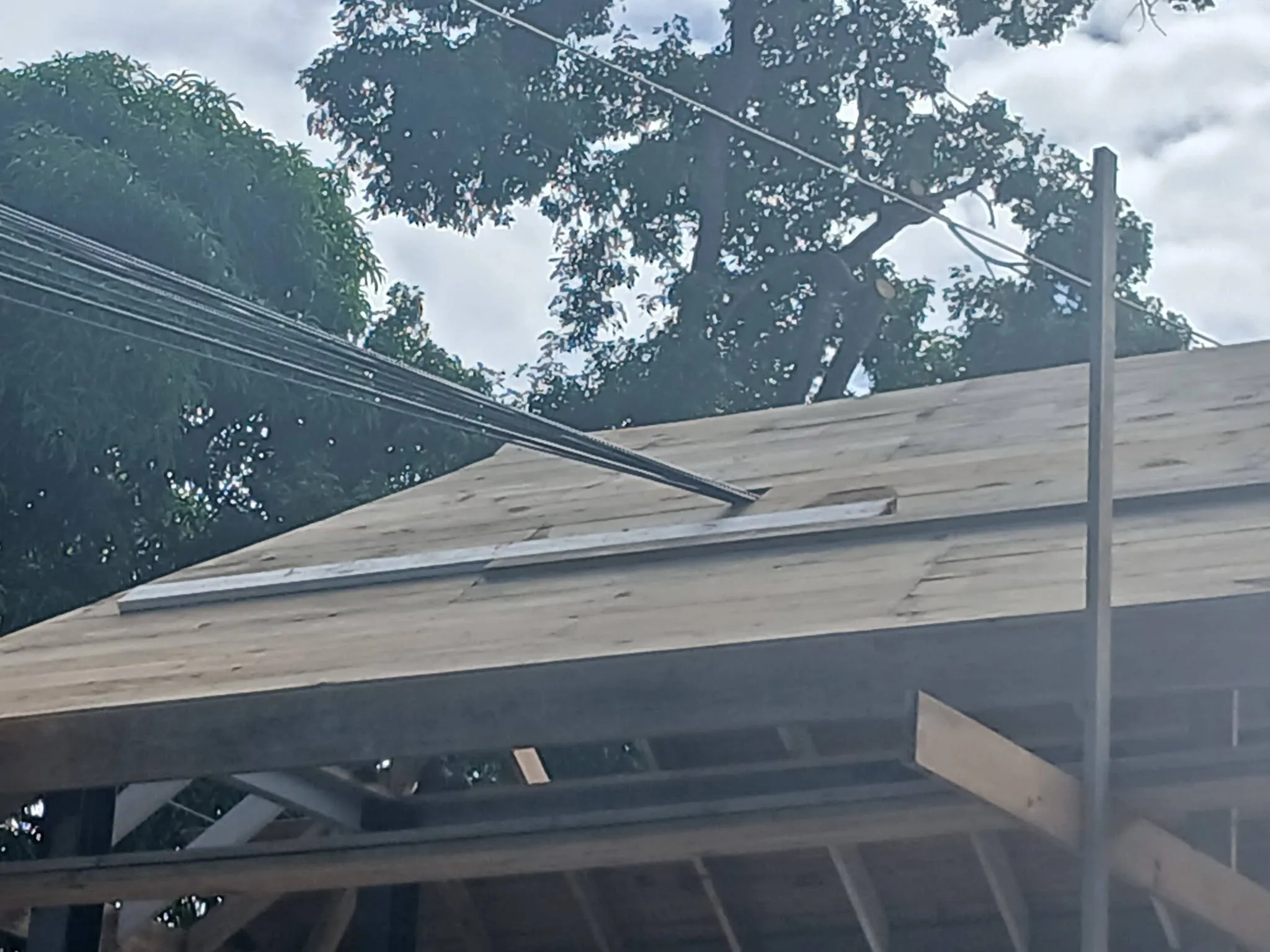
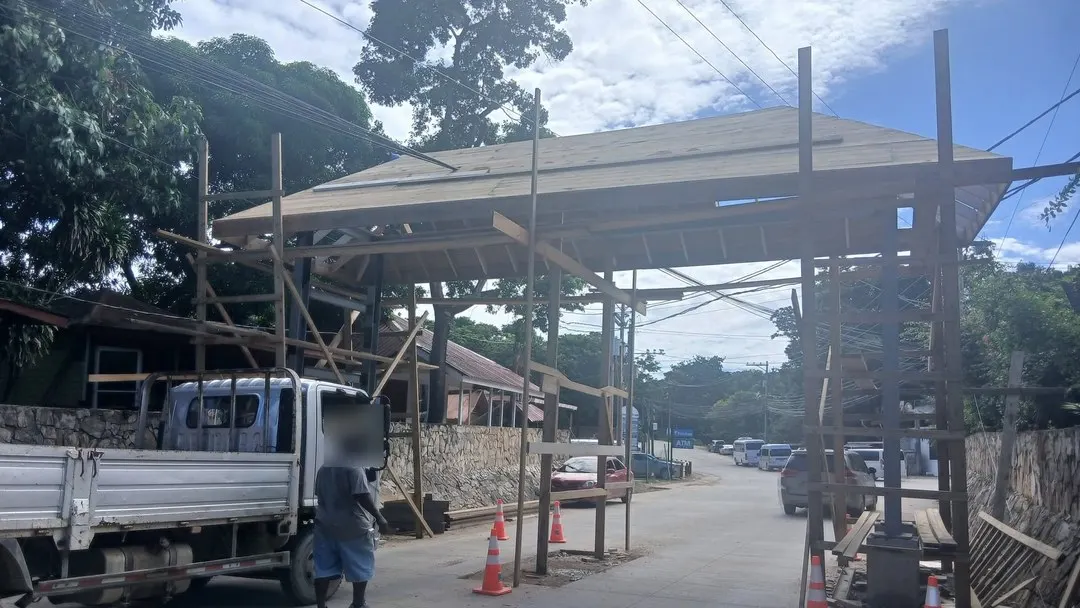
The bundle of wires doesn’t pass over the roof. It passes into it. Somebody measured, marked, and cut a notch in the plywood to let the cables through. Then they laid a board over the top, like tucking in a child.
My inner electrician just fainted.
In the US (OSHA) and in Canada, the baseline rule for anyone who isn’t a lineworker is roughly 10 feet (3 meters) of clearance from an overhead line. Here the clearance is zero. The wires are part of the framing.
Are they power lines, cable TV or internet? I don’t know. And that’s exactly the problem: nobody on a job site should have to guess. A wire is live until proven otherwise. And when the wind tugs a bundle that rubs against wood for years, the insulation eventually loses.
C3S: Safety, Safety, Safety
My house standard is called C3S. It fits in three words: Safety, Safety and Safety. Here’s the inspection, worst first:
- Overhead lines. See above. I’m not going back there, my hands are still shaking.
- Scaffolding. Single 2x4 uprights standing on concrete, no base plates, no full bracing, no guardrails. Some uprights stick out past the roof and hold on to nothing. This is scaffolding that runs on faith.
- Work at height. No lifeline or harness in sight. The roof is what, 15 feet up? Over a concrete road.
- Traffic. The road is open under a structure that’s still being built. A handful of orange cones. No flagger, no “hombres trabajando” sign. Cars roll under a plywood roof and hope it’s a quiet day.
- PPE. No hard hat, no hi-vis vest, no safety boots. The worker in the photo walks in the lane in shorts and sneakers. (We blurred his face. We’re teasing the job site, not him.)
- The truck. Parked in the traffic lane, right next to the scaffolding. If anybody backs up, everyone gets a physics lesson.
The international standard for occupational health and safety is ISO 45001. I don’t think it’s gotten off the boat yet.
ISO 14001: the environmental side
ISO 14001 is the environmental management standard. A job site that follows it sorts its waste, protects the ground and leaves nothing lying around. Here:
- planks stacked on the shoulder, nails included;
- broken pavers in the ditch;
- a styrofoam food container that will be in the sea after the first good rain;
- and above all: the palm trees from the render aren’t there. It needs about ten. I’m counting on the Alcaldía for those, because a gate without palm trees is a bus shelter.
Our theory: nobody waited for RECO
In Roatán, RECO (Roatan Electric Company) handles the power lines. Moving a line takes RECO, RECO’s schedule and a lot of patience.
Our theory, and I do mean theory: the job site didn’t want to wait for RECO. The wires were there, the roof had to go up, so the roof went up around the wires. We have no proof. We just have a photo, and it speaks loudly.
If RECO comes to move the lines before the roofing is done, this post becomes a story with a happy ending. I’ll let you know.
So, do you drive under it?
Yes, West End is still open. When we took our photos, the road was open under the structure. My advice:
- Drive slowly and give the work truck some room.
- Don’t stop under the structure for a photo. Take it from a distance; the angle is better anyway.
- On foot, walk on the stone-wall side, away from the scaffolding.
If you’re looking for where to stay nearby, I break down the village in Where to stay in Roatán: West Bay, West End or elsewhere. You can also watch West End live on our Roatán webcams. And yes, despite this job site, Roatán is safe: it’s just the gate that isn’t, yet.
The bottom line is still good news: a gate, a boardwalk and colorful letters are a real investment in West End. We want to see it finished, with its palm trees, its guard booth and its wires far away from the roof.
Roatán Avanza. Slowly, and ideally with a hard hat.
Want to see West End with someone who knows the island? Check out our Roatán tours.
Frequently asked questions
Who is building the new West End gate in Roatán?
The Alcaldía de Roatán (the municipality). Its logo is on the project renders, which carry the motto Roatán Avanza.
Who designed the West End gate?
The renders are signed "Diseño: Arq. Jorge Aníbal Meza".
When will the West End gate be finished?
No completion date has been published. When we took our photos, the roof deck was up, with no roofing or trim yet.
Can you still get to West End during construction?
Yes. The road stayed open under the structure when we took our photos. Drive slowly and don't stop underneath it.