Bill C-22 Explained: What Canada's Lawful Access Act Would Change for Your Privacy
I have lived on Roatán since 2014, and I guide visitors here in English, French and Spanish. My phone, my email and most of my guests are still Canadian, so when Ottawa writes a law about access to our data, it concerns me, and it concerns you.
Bill C-22 drew tens of thousands of Google searches in Canada this spring. I read the official text, the briefs and the testimony before Parliament. Here is what it would do, why so many people are worried, and what it means when you travel.
The short answer: what is Bill C-22?
C-22 is the Lawful Access Act, 2026. It has two main parts:
- it gives police and CSIS new ways to obtain subscriber information and data;
- it requires electronic service providers (telecoms, messaging, email, VPNs, apps) to facilitate that access.
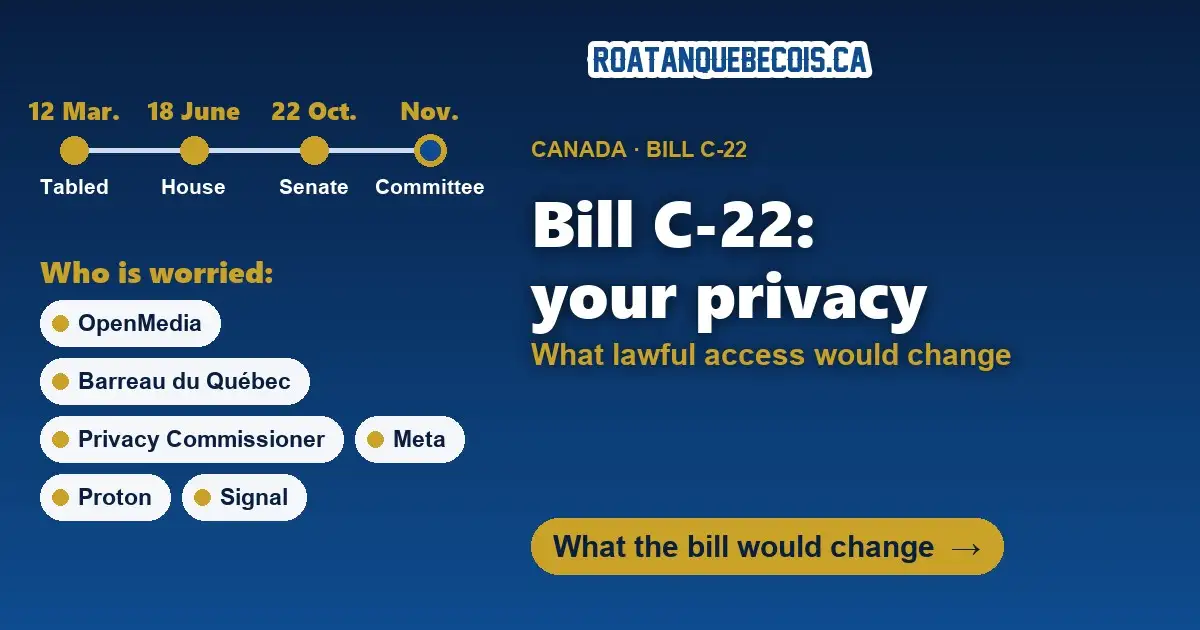
Where it stands, on 2 November 2026:
| Stage | Date |
|---|---|
| Tabled in the House (first reading) | 12 March 2026 |
| Passed by the House (third reading) | 18 June 2026 |
| Second reading in the Senate | 22 October 2026 |
| Senate National Security committee study | under way |
It is not in force. The Senate can still amend it.
What the bill would allow, in plain words
According to the text passed by the House on 18 June 2026:
- Demands to telecoms: an officer can require a provider to confirm whether it serves a given customer or number, on “reasonable grounds to suspect” an offence. That is a lower bar than “reasonable grounds to believe”.
- A new production order for subscriber information, and access without an order in exigent circumstances.
- Secrecy: police can bar the provider from revealing it received a demand for up to one year.
- Part 2, the new Supporting Authorized Access to Information Act: the government could require major providers to retain categories of metadata for up to six months (who contacted whom, when, from where), excluding message content, web browsing history and social media activity.
- Ministerial orders valid for up to two years, which the company must keep confidential.
- International assistance: foreign orders could be enforced against people in Canada.
What has already changed since March
The March text is not the June text. The House amended it, and fairness means saying so:
- metadata retention went from one year to six months at most;
- the text now says no obligation compels a provider to decrypt, or make decryptable, what its customer encrypted. The Privacy Commissioner welcomes this change himself;
- a provider does not have to comply if it would create a “systemic vulnerability” in its electronic protections.
That is better. But the criticism has not gone away, and here is why.
The dangers critics raise, one by one
- A low bar for sensitive information. Subscriber information can touch health services, lawyers, banks or dating apps, says the Privacy Commissioner. He finds the definition too broad for a mere “suspicion”.
- Secret orders. A company can receive a ministerial order valid for two years and be unable to tell its customers.
- Six months of metadata on everyone. Not just suspects: the customers of the major providers named by regulation. Proton points out that the European Union’s top court has struck down this kind of general data retention twice.
- Encryption, despite the amendment. Part 2’s technical obligations could push companies to build access capabilities into their systems. Signal fears those weaknesses, once built, would serve hackers too.
- “Publicly available” information, never defined. Police would not need an order for what is public, but the bill does not say what that covers. The Commissioner notes that public information does not automatically lose all expectation of privacy.
Who opposes it, and why
The bill has raised serious concerns from digital rights groups (such as OpenMedia), the Barreau du Québec, the Privacy Commissioner of Canada and technology companies (such as Meta, ProtonVPN and Signal), who fear privacy violations, weaker encryption or harm to the country’s digital competitiveness.
What each one says, in their own words:
- OpenMedia, which calls itself Canada’s largest grassroots digital rights community, asks Parliament to withdraw C-22 or strip out its surveillance powers. Its brief to the Commons committee is dated 15 May 2026.
- The Barreau du Québec (brief of April 2026) asks to clarify “subscriber information”, to raise the bar to “reasonable grounds to believe”, to remove voluntary disclosure without judicial oversight, and to protect solicitor-client privilege.
- The Canadian Bar Association (May 2026) says the new bill is better than the last one, but still needs work.
- The Privacy Commissioner of Canada spoke to the House on 26 May and to the Senate on 2 November 2026. He acknowledges improvements and recommends narrowing the definition of the information covered and who can be compelled to provide it.
- Meta (Commons committee, May 2026) supports Part 1 with amendments, but says Part 2’s sweeping powers and weak safeguards would end up “making Canadians less safe, not more”.
- Proton VPN, on 19 May 2026: “there is no universe in which Proton VPN compromises its no-logs policy.” In October, chief technology officer Bart Butler told The Globe and Mail that Proton is no longer exploring a North American headquarters in Canada, and that expanding here would be impossible if the bill passes as drafted. That is the digital competitiveness argument.
- Signal, through Udbhav Tiwari, vice-president of strategy and global affairs, in The Globe and Mail on 14 May 2026: the company “would rather pull out of the country than be compelled to compromise on the privacy promises we have made to our users.”
And when you travel? Your phone, your messages and your VPN
C-22 changes nothing about your flight, your arrival in Honduras or your tours. But it targets the providers that serve you in Canada. Three things to know before you leave:
- Your roaming plan is still Canadian. When you use your phone on Roatán with roaming, your Canadian carrier is serving you, and that is who the law would cover. A local eSIM or SIM card goes through a foreign carrier, under its own country’s laws. I cover the options in the Roatán SIM card guide.
- Your apps will not change overnight. The bill has not passed. If Signal or a VPN ever left Canada, it would be announced; keep your apps updated and read their notices.
- End-to-end encryption is still your best protection, at home and on the road.
Read the text yourself
Official documents first, then our copies, kept unchanged in case links move:
- The bill, on Parliament’s site: LEGISinfo, C-22 (45-1) and the official PDF, as passed by the House on 18 June 2026.
- Our copy of that PDF, bilingual, 74 pages: Bill C-22 as passed by the House. To compare, the first-reading version of 12 March.
- The briefs: Barreau du Québec (copy, in French), OpenMedia (copy), Canadian Bar Association (copy).
- The Privacy Commissioner: statement to the Senate, 2 November 2026 and remarks to the House, 26 May 2026.
Everything here was checked on 2 November 2026. I will update this post once the Senate votes.
This post explains a bill; it is not legal advice.
Planning a trip? Browse our Roatán tours, and message me with any question, in English, French or Spanish. See you on the island.
Frequently asked questions
What is Bill C-22?
It is the Lawful Access Act, 2026, tabled on 12 March 2026 by the Minister of Public Safety. It gives police and CSIS new ways to obtain subscriber information and data, and it requires electronic service providers to facilitate that access.
Has Bill C-22 passed?
Not yet. The House of Commons passed it on 18 June 2026. In the Senate it passed second reading on 22 October 2026 and is now being studied in committee. It is not in force.
Does Bill C-22 force companies to break encryption?
The text passed by the House says no obligation compels a provider to decrypt, or make decryptable, information its customer encrypted. Critics still object to secret orders, metadata retention of up to six months, and technical obligations that Meta, Signal and Proton call a security risk.
Who opposes Bill C-22?
OpenMedia, the Barreau du Québec, the Canadian Bar Association, the Privacy Commissioner of Canada (who is asking for amendments), Meta, Proton and Signal, among others.
Does Bill C-22 affect my trip to Roatán?
Not your flight or your tours. But if it passes, it targets the providers that serve you in Canada, including your mobile carrier, which is still your Canadian carrier when you roam abroad.