Fishing in Roatán
Roatán gives you three different fisheries from one island, and blue water sits closer to shore than almost anywhere else in the Caribbean. What follows is what we can actually show you — the state of the sea over thirty years, the species on record, and the moon. Where we do not know yet, we say so.
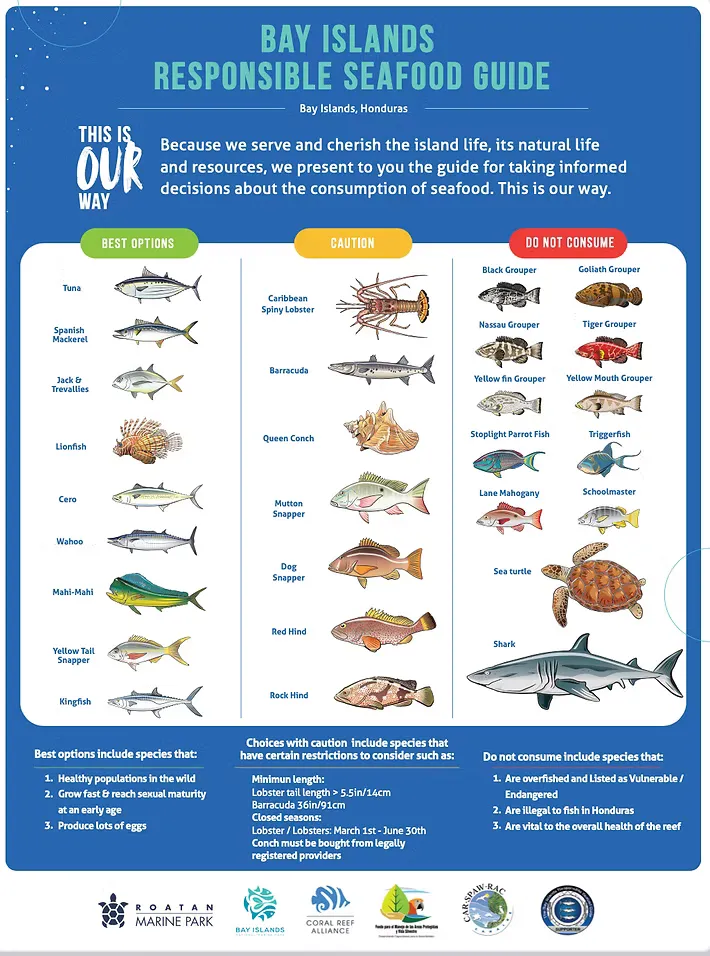
The four numbers on that poster
- Lobster tail over 14 cm (5.5 in), and the season is closed from 1 March to 30 June. Both are law, not advice.
- Barracuda over 91 cm (36 in).
- Conch must come from a legally registered supplier.
- Marlin and sailfish go back in the water. Article 41 of the fisheries law puts the picudos under captura y liberación, catch and release. That one is not on the poster, it is in the law.
The sport species you will see most at Roatán
Divers log what they see into OBIS, a public biodiversity database. Counting those entries inside a box around the island gives the ranking below, and these come up more often than any other sport species. Every one of them appears on the Roatán Marine Park guide above, and the run breaks only at the cubera snapper, which the poster does not list at all.
🔴 6 of them are in the park's red column. Including the second most-recorded on the list below. You can catch some of them legally. The island still asks you not to eat them.
- Sphyraena barracuda logged 116 times by divers conditions apply
- Lutjanus apodus logged 114 times by divers do not consume
- Caranx ruber logged 88 times by divers best option
- Ocyurus chrysurus logged 60 times by divers best option
- Lutjanus analis logged 59 times by divers conditions apply
- Mycteroperca tigris logged 58 times by divers do not consume
- Epinephelus striatus logged 50 times by divers do not consume
- Mycteroperca bonaci logged 49 times by divers do not consume
- Lutjanus mahogoni logged 37 times by divers do not consume
- Lutjanus jocu logged 29 times by divers conditions apply
- Mycteroperca venenosa logged 26 times by divers do not consume
⚠️ Most recorded is not most caught. These counts come from divers on the reef, so a fish that sits still in shallow water outranks one that does not. The open-water species are missing from this ranking entirely, for the same reason: nobody runs reef surveys twenty miles offshore.
Three fisheries, one island
The island sits on the edge of a steep shelf. Deep water is close, the northwest flats are shallow and clear, and the Mesoamerican Barrier Reef — the second largest reef system in the world — runs along the south side. Offshore, flats and reef are three different days on the water, not three names for the same trip.
When the sea actually lets you out
Every charter page tells you what bites. None of them tells you how often the sea is calm enough to go. Here is that, month by month, from thirty years of the ERA5 reanalysis, for the median day and for the rougher end of the range.
September is the flattest month of the year: 0.76 m of swell and 17.3 km/h of wind on a median day. June is the windiest, at 26.8 km/h. The trades blow from the east or east-northeast almost all year.
| Month | Wind, median | Wind, 1 day in 10 | Swell, median | Swell, 1 day in 10 | From |
|---|---|---|---|---|---|
| January | 21.4 km/h | 33 km/h | 1.11 m | 1.74 m | ENE |
| February | 23.2 km/h | 34.5 km/h | 1.12 m | 1.62 m | ENE |
| March | 24.3 km/h | 36.5 km/h | 1.13 m | 1.74 m | ENE |
| April | 25 km/h | 37 km/h | 1.11 m | 1.68 m | E |
| May | 24.2 km/h | 35.8 km/h | 1.02 m | 1.55 m | E |
| June | 26.8 km/h | 36.3 km/h | 1.13 m | 1.57 m | E |
| July | 25.7 km/h | 34.9 km/h | 1.02 m | 1.42 m | E |
| August | 22.3 km/h | 33 km/h | 0.88 m | 1.32 m | E |
| September | 17.3 km/h | 29.8 km/h | 0.76 m | 1.2 m | E |
| October | 16.3 km/h | 30.4 km/h | 0.8 m | 1.36 m | shifting |
| November | 17.7 km/h | 30.9 km/h | 0.98 m | 1.65 m | shifting |
| December | 17.9 km/h | 30 km/h | 1.02 m | 1.56 m | ENE |
⚠️ Two things this table is not. It is an offshore climate: the ERA5 grid cell is about 31 km across and Roatán sits inside one, so the model sees open sea, not the lee of the island — the south side is calmer than this in a norther. And “shifting” in October and November is real, not missing data: the trades break down at the height of hurricane season, and the wind has no settled direction those two months.
🔴 What is still missing here. The column that would matter most — how many days a month fall under the wind and swell at which a trip is actually called off, needs those two thresholds from the operator. We have not invented them. See also the full weather page and what 132 years of hurricane records say.
Mahi-mahi and wahoo, first
Two fish carry offshore fishing off Roatán, and everything else out there is a bonus on top of them: mahi-mahi and wahoo. If you book a day at the drop-off, these are what the day is built around.
🔴 Neither of them appears in the species list further down, and that is not an oversight. That list comes from OBIS, which is built from counts made on the reef. Nobody counts fish twenty miles offshore, so every open-water species fell out of it. ⚖️ The honest fix is a second source, named as such, rather than quietly adding rows to the first one.
Marlin, sailfish and the law that covers them
Honduras groups the billfish under one word, picudos, and four of them are on record in this part of the Caribbean.
- Blue marlin Makaira nigricans
- White marlin Kajikia albida
- Atlantic sailfish Istiophorus albicans
- Longbill spearfish Tetrapturus pfluegeri
🔴 All four go back in the water. Article 41 of the fisheries law puts the picudos under “captura y liberación”, catch and release. Not a captain’s house rule. The law. Naming these fish without saying so would be inviting an offence.
⚠️ The sailfish carries two valid names. WoRMS accepts both Istiophorus albicans for the Atlantic and Istiophorus platypterus for a single worldwide species. That is a live disagreement among taxonomists, not a typo, and we use the Atlantic name while saying so.
Swordfish are on record here too, and they sit apart: they are caught deep and at night, which has nothing to do with a day trip. Tuna round out the open water — Yellowfin, Blackfin, Little tunny, Skipjack.
🟢 How we know they are here. Every name above was checked against WoRMS for a valid, accepted spelling, then against OBIS records across the western Caribbean. ⚖️ Presence, not abundance. The record counts measure how much people looked, not how many fish there are, so we do not rank anything by them and neither should you.
🔴 And no seasons on this page yet. OBIS dates every observation, but that date says when somebody looked. A season built from it would be the schedule of research cruises, not of fish.
What swims here
These are the sport species on record inside a box around the island, taken from OBIS, the Ocean Biodiversity Information System — 343 fish species in total, of which the ones below are the ones anglers come for. Every name is checkable against the source.
barracuda
- Sphyraena barracuda Sphyraenidae eat with caution
bonefish
- Albula vulpes Albulidae
grouper
- Epinephelus guttatus Epinephelidae eat with caution
- Epinephelus striatus Epinephelidae closed indefinitely
- Mycteroperca bonaci Epinephelidae closed Nov to Apr
- Mycteroperca interstitialis Epinephelidae do not eat
- Mycteroperca tigris Epinephelidae closed Nov to Apr
- Mycteroperca venenosa Epinephelidae closed Nov to Apr
jack
- Caranx bartholomaei Carangidae
- Caranx hippos Carangidae
- Caranx latus Carangidae
- Caranx ruber Carangidae
mackerel
- Scomberomorus regalis Scombridae
palometa
- Trachinotus goodei Carangidae
snapper
- Lutjanus analis Lutjanidae eat with caution
- Lutjanus apodus Lutjanidae do not eat
- Lutjanus cyanopterus Lutjanidae
- Lutjanus griseus Lutjanidae
- Lutjanus jocu Lutjanidae eat with caution
- Lutjanus mahogoni Lutjanidae do not eat
- Lutjanus synagris Lutjanidae do not eat
tarpon
- Megalops atlanticus Megalopidae
yellowtail snapper
- Ocyurus chrysurus Lutjanidae
🔴 More than half the list above carries a warning. 1 carries a permanent ban and 3 more are closed from November to April, 8 are on the local “do not consume” list, and 4 come with conditions. That is not a footnote on a page that tells you what to catch, so it is marked on every line and set out in full below.
⚠️ Presence, not season — and an important gap. These records come from divers counting fish on the reef. That means two things. The dates attached to them say when people looked, not when the fish were there. And the open-water species (tuna, wahoo, mahi-mahi, marlin, sailfish) are absent from this list simply because nobody runs reef surveys twenty miles offshore. Their absence here says nothing about their presence in the water.
Seasons — we are not going to guess
You will find month-by-month species calendars on other Roatán fishing pages. We have not published ours, because we could not verify it. Two reasons, both worth knowing:
- No database can give it. We checked OBIS and GBIF: their dates record survey effort, not fish. A season computed from them would be measuring dive-club calendars.
- The published calendars disagree with each other — and with our own working estimate, by months, for the same species. When two sources conflict and neither shows its working, the honest answer is to wait.
This section will be filled in from local captains, and it will say who it came from. Until then, ask the operator you book with — and ask them how they know.
The moon, and why it matters
The moon, and why it matters here
Three things on Roatán run on the moon rather than on the calendar, and none of them is folklore.
- Bioluminescence. The plankton glow is drowned out by moonlight. The nights around a new moon are the dark ones, and they are the only ones worth going out for.
- Night dives. Same logic in reverse: a full moon lights the reef and changes what comes out. Neither is better — they are two different dives.
- Fishing. Several grouper and snapper species gather to spawn around the winter full moons. ⚠️ Those gatherings are exactly when some of them are protected — check before you plan a trip around one.
2026
- New moon Saturday, October 10, 2026 09:51
- Full moon Sunday, October 25, 2026 22:12
- New moon Monday, November 9, 2026 01:03
- Full moon Tuesday, November 24, 2026 08:54
- New moon Tuesday, December 8, 2026 18:53
- Full moon Wednesday, December 23, 2026 19:29
2027
- New moon Thursday, January 7, 2027 14:26
- Full moon Friday, January 22, 2027 06:18
- New moon Saturday, February 6, 2027 09:57
- Full moon Saturday, February 20, 2027 17:24
- New moon Monday, March 8, 2027 03:31
- Full moon Monday, March 22, 2027 04:45
- New moon Tuesday, April 6, 2027 17:52
- Full moon Tuesday, April 20, 2027 16:28
- New moon Thursday, May 6, 2027 05:00
- Full moon Thursday, May 20, 2027 05:00
- New moon Friday, June 4, 2027 13:41
- Full moon Friday, June 18, 2027 18:46
- New moon Saturday, July 3, 2027 21:03
- Full moon Sunday, July 18, 2027 09:46
- New moon Monday, August 2, 2027 04:06
- Full moon Tuesday, August 17, 2027 01:30
- New moon Tuesday, August 31, 2027 11:42
- Full moon Wednesday, September 15, 2027 17:05
Computed with the Meeus lunar algorithm, checked against a published new moon and correct to the minute. Times are Roatán local (UTC−6, no daylight saving). ⚠️ Computed on September 28, 2026, and the moon does not repeat yearly the way the sun does: if you are reading this well after that date, the first lines may already have passed.
What you are not allowed to catch
Most finfish here have no closed season at all. The exceptions are the ones worth knowing, and they are strict. Everything below comes from Acuerdo Ministerial No. SAG-06-2025, published 2025-03-04 in Honduras’ official gazette (No. 36 781).
| Species | Rule | Article |
|---|---|---|
| All parrotfish (Scaridae) and surgeonfish (Acanthuridae) | Closed indefinitely (veda indefinida) | SAG-06-2025, SEPTIMO |
| Nassau grouper | Closed indefinitely (veda indefinida) | SAG-06-2025, OCTAVO |
| Tiger, yellowfin and black grouper | Closed 1 November to 30 April (veda temporal) | SAG-06-2025, NOVENO (1 Nov 2025 to 30 Apr 2026) |
| Every shark species | Closed indefinitely (veda indefinida) | SAG-06-2025, DECIMO; Decreto Legislativo 26-2016, La Gaceta, 23 May 2016 |
| Caribbean spiny lobster | Closed 1 March to 30 June | SAG-06-2025, PRIMERO; same window in 001-2021 and 67-2024 |
| Queen conch (caracol rosado) | Seasonal closure | SAG-06-2025, TERCERO |
| Sea cucumbers | Closed indefinitely (veda indefinida) | SAG-06-2025, SEXTO |
⚖️ The November–April grouper closure and the moon are the same fact. The decree gives its own reason: that window is when those groupers form their largest spawning aggregations. The moon calendar above is not folklore, it is the biology the law is built on.
⚠️ Seasonal dates are renewed by ministerial decree every year. The indefinite bans hold until further notice; the dated ones do not. Check the current decree before you plan around them.
What the island itself recommends
Alongside the law there is a local consensus: the Bay Islands Responsible Seafood Guide, produced by the Roatán Marine Park, the Bay Islands National Marine Park, the Coral Reef Alliance and their partners. It answers a different question from the decree. The decree says what you may take. The guide says what is worth eating, and it goes further. The park calls it a traffic-light system, and publishes it at roatanmarinepark.org/rsg.
Best options
- Tuna
- Spanish Mackerel
- Jack & Trevallies
- Lionfish
- Cero
- Wahoo
- Mahi-Mahi
- Yellowtail Snapper
- Kingfish
With caution
- Caribbean Spiny Lobster
- Barracuda
- Queen Conch
- Mutton Snapper
- Dog Snapper
- Red Hind
- Rock Hind
Do not consume
- Black Grouper
- Goliath Grouper
- Nassau Grouper
- Tiger Grouper
- Yellowfin Grouper
- Yellowmouth Grouper
- Stoplight Parrotfish
- Triggerfish
- Lane Snapper
- Mahogany Snapper
- Schoolmaster
- Sea turtle
- Shark
🟢 Lionfish heads the best list, and that is not a mistake. It is invasive here. Taking more of it helps the reef, which makes it the one species on this page where restraint is the wrong instinct.
⚖️ The guide is stricter than the law, and both stand. Yellowmouth grouper and the lane, mahogany and schoolmaster snappers carry no legal closure at all, and the island still asks you not to eat them. Where the two meet, the decree decides what is allowed and the guide what is reasonable.
Two figures from the guide that are law, not advice: a lobster tail must exceed 14 cm, and a barracuda 91 cm. Conch must come from a legally registered supplier.
Inside the marine park
Roatán sits inside the Bay Islands National Marine Park. The park publishes what is allowed, and the list includes artisanal hand-line fishing and lionfish hunting, alongside diving, snorkelling and boat transit under 20 knots.
Billfish go back in the water. That is the law.
Marlin and sailfish, the fish Honduras calls picudos, are covered by a single sentence in the fisheries law: they are subject to “captura y liberación”, catch and release. Not a sporting convention, not a house rule of a good captain. The law, Decreto Legislativo No. 106-2015 — Ley General de Pesca y Acuicultura, article 41.
And the licence question, answered
Another Roatán fishing page states flatly that visiting anglers need no licence, and cites nothing. The law is more precise than that, and the difference matters. Article 41 puts the operation and the vessel under licence, not the person holding the rod. Article 66 lists “pesca turística o deportiva” among the licences that exist. Article 42 requires one for foreign vessels.
⚖️ So the honest answer is not “no licence needed”. It is: the licence exists, it belongs to the boat you step onto, and you are entitled to ask to see it. Bring your own boat and the question changes entirely.
Where the park begins, and where it ends
The Bay Islands National Marine Park covers 647,152.49 hectares, which makes it the largest protected marine area in Honduras. It takes in Utila, Roatán and Guanaja along with Barbareta, Morat, Santa Elena and more than sixty cays. It became a national park in 1997 and a protected marine area on 10 June 2010.
🟢 Its zoning is drawn by depth, not by coordinates, which is what makes it usable from a boat. The Coastal Zone runs from the high tide line out to 10 m of water. The Special Marine Zone runs from the high tide line out to 60 m. Beyond that a Buffer Zone extends twelve nautical miles further. Your sounder tells you which one you are in.
What the park forbids outright
- Use of net and harpoon for fishing
- Capture of lobster and conch
- Mangrove cutting
- Fishing of herbivorous species
- Anchoring on the reef
- Constructions
⚖️ Three of those six match the national decree word for word: harpoon, lobster and conch, herbivorous species. When a park rule and a fisheries law agree without citing each other, you can treat the rule as settled rather than as local custom.
Going without a guide
Wading the flats with your own rod is a real option here, and almost nobody writes about it because there is nothing to sell. Two honest cautions before you do: the regulations above apply to you exactly as they apply to a charter, and the sea state table further up is the offshore picture. The flats are calmer, but a norther still ends the day.
Common questions
When is the sea calmest?
September, on the thirty-year record: 0.76 m of swell and 17.3 km/h of wind on a median day. ⚖️ That is also the height of hurricane season. The two facts sit together and we would rather you hear both.
Do I need a fishing licence?
Not one of your own, if you go out with a local boat. Honduras’ fisheries law licenses the operation and the vessel, not the individual angler. Ask your operator to show you theirs. If you bring your own foreign boat, that is a different matter and it does need a licence.
Is Roatán good for fly fishing?
The northwest flats hold bonefish, permit and tarpon. All three are on the OBIS record above. How they run through the year is the season question we have not answered yet.
Which months are roughest?
June, on the thirty-year record, at 26.8 km/h of median wind. October and November are the unpredictable ones rather than the strongest: the trades lose their direction entirely those two months, so a settled forecast means less than usual.
Can I keep what I catch?
Some of it. Honduras has no general closed season on finfish, but parrotfish, surgeonfish, Nassau grouper and every shark species are under an indefinite ban, and three more groupers are closed from November to April. The section above lists them by name.
Is there a spearfishing option?
Inside the marine park the published list of permitted activities names hand-line fishing and lionfish hunting. It does not name spearfishing for other species. We are confirming the exact wording with the park before saying more.
Ask Patrice what the sea will do my week
Sea state: ERA5 reanalysis, Copernicus Climate Change Service (C3S) / ECMWF, 1991–2020 normal. Neither the European Commission nor ECMWF is responsible for any use of this data. Species: OBIS, Ocean Biodiversity Information System, box surveyed 2026-09-20. Moon: Meeus lunar algorithm, computed here.