Mitchell-Hedges Skull: the Hoax, and What He Really Found
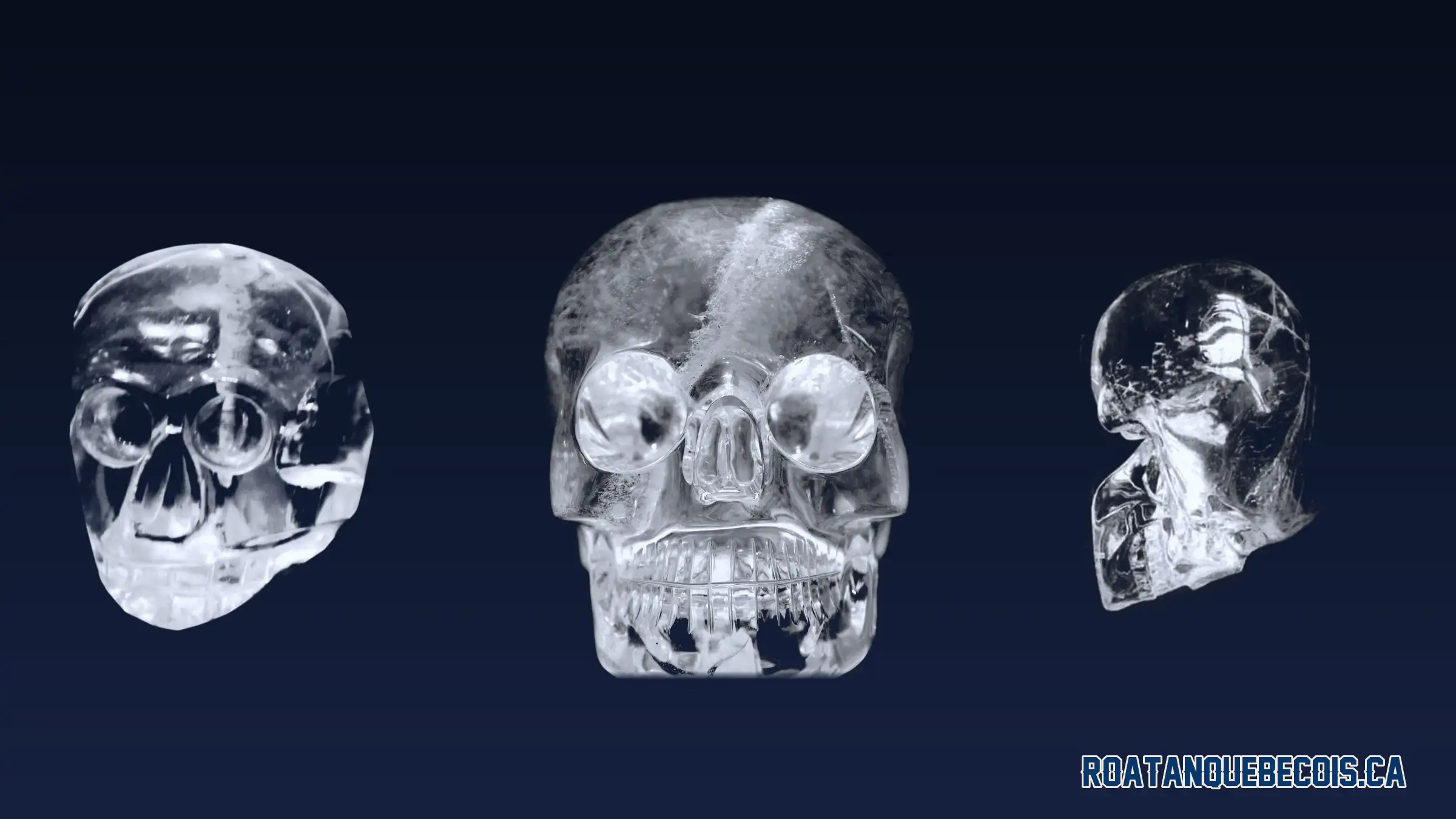
⚠️ The header shows three skulls, and they are not three angles of the same object. They are three separate objects, and three fakes. Left, a crystal skull from the National Museum of Anthropology in Mexico City. ⚠️ No acquisition date is published for that object, and we are not borrowing one. Centre, facing forward and complete, the British Museum skull. Right, the Mitchell-Hedges, as it appeared in the Sotheby’s sale catalogue of 15 October 1943, and it is the only free photograph of that skull in existence: a profile, and there is no other. ⚠️ The Smithsonian skull, discussed further down, is NOT in the picture: its photograph is not reusable. ⚖️ The labels say where each object is today, and nothing else. The dates live in the text, where there is room to say what they mean: the British Museum registers its purchase in 1898, Mitchell-Hedges buys his in 1943, and Mexico City’s is not published (Jane Walsh documents two small skulls bought by that museum in 1874 and 1880, but nothing identifies this one with either). Catalogue photo: Periodyssey (Steve Culp), CC BY-SA 3.0. British Museum skull: Rafał Chałgasiewicz, CC BY 3.0. Mexico City skull: Gary Todd, CC0. All three cut out and composited by us.


.jpg)
Two things are true about Frederick Albert “Mike” Mitchell-Hedges, and almost nobody tells you both.
His famous crystal skull is a fake. Not disputed, not “controversial”: a fake, with tool marks to prove it.
And he really did dig here. On Roatán, on Santa Helena, on Barbareta. The objects sit in a Smithsonian catalogue with his name on them, and the director of the museum that took them called the find one of the most important in a decade in Central America.
That second half never made television.
Who was F. A. “Mike” Mitchell-Hedges?
An English adventurer, 1882 to 1959, who made a career out of being one. He started as a clerk on the London Stock Exchange at sixteen, spent his twenties day-trading in Manhattan, and came home at twenty-three with something over four thousand pounds, roughly half a million in today’s money. Then he decided to become an explorer.
He was, by wide agreement, a spectacular liar. Contemporaries nicknamed him the British Baron Munchausen. Every fish he caught was the largest ever caught in that water. He said Pancho Villa took him hostage in 1913 and that he then joined the general’s army. He claimed to have unearthed relics twenty-five thousand years old from Atlantis.
He was not funded by a university. He was funded by rich patrons, chiefly Lady Richmond Brown, with whom he began an affair in 1921 and who paid for the boats and the expeditions, by newspapers that bought his dispatches, by books, and by paid lecture tours.
He also said, on the record, that he had given museums in England and the United States “some thousands of specimens” and that “never have I accepted a penny from a museum or institution.”
🔴 That claim does not survive the Smithsonian’s own files. Its object records do say donated, not purchased, and so far so good. But the archival biography of him held by the National Museum of the American Indian says something else outright: his expeditions with Lady Richmond Brown “were often taken under the auspices of the British Museum or Museum of the American Indian, Heye Foundation.”
Institutional backing is not nothing, whatever he chose to call it. The honest version is that he gave objects away and took sponsorship, and told the public only the first half.
Either way the commercial pressure was real, and it rode on the lectures and the books. A man whose ticket sales depend on his finds being extraordinary has a standing reason to make them sound extraordinary.
Keep that in mind. It does not make his Roatán collections fake. It explains the skull perfectly.
And one detail that gets lost in every retelling: he was not looking for a crystal skull. He was looking for a lost Maya city.
Is the Mitchell-Hedges crystal skull real?
No.
Quartz cannot be carbon dated, there is no organic material in it, so you date the carving instead. Ancient Mesoamerican workers shaped hard stone with stone tools, cord and abrasive sand, which leaves irregular, uneven grooves. Modern lapidary work uses high-speed rotary wheels with diamond abrasives, which leaves precise, parallel, circular arcs.
Margaret Sax tested several crystal skulls at the British Museum in 1996. In 2008, after Anna Mitchell-Hedges died, her husband Bill Homann brought this one to the Smithsonian. Under the electron microscope the teeth, the jaw separation and the base of the skull showed rotational tool marks, and traces of modern synthetic lubricants.
And there is a plainer point the archaeology has never budged on: no crystal skull has ever been recovered from an archaeological excavation. Not one, anywhere. The Maya carved skulls in stone, on temples and in relief. They did not carve them in quartz.
Where the skulls actually come from
The trail runs through Paris and Mexico City, not through a jungle.
Around 1860 a French dealer named Eugène Boban was working in Mexico, in the middle of a Maya craze. Local artisans were already carving small quartz skulls and selling them to tourists, alongside pendants and bracelets. Boban saw the business in it. He ran a shop that sold genuine artefacts and fakes side by side, and he had skulls carved in Idar-Oberstein, Germany, from Brazilian quartz, in a faux-Aztec style, then sold them to museums and collectors as pre-Columbian.
Boban did not invent the object. He invented its age.
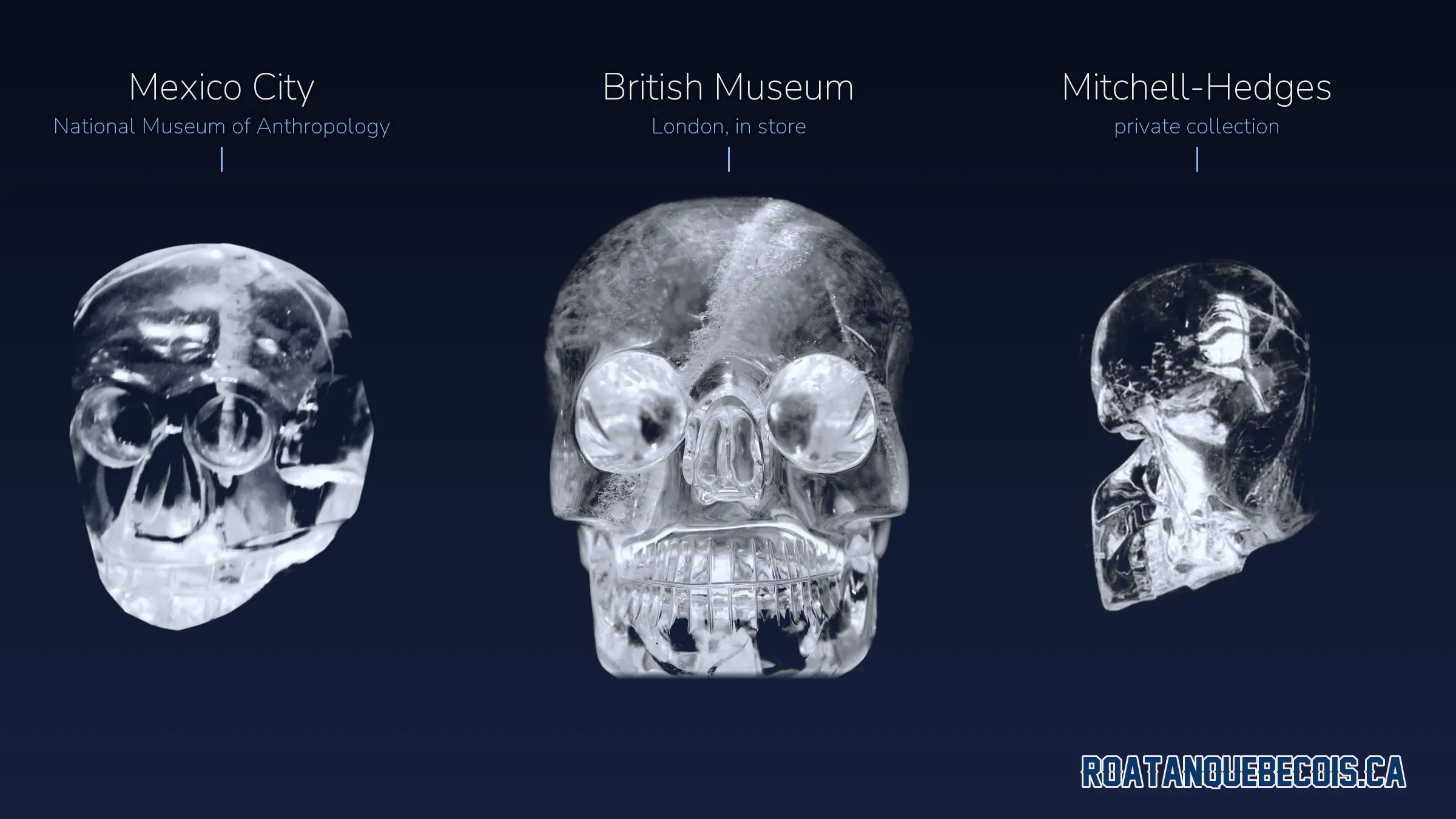
The three objects, named. Left, a crystal skull from the National Museum of Anthropology in Mexico City, with no published acquisition date. Centre, the British Museum skull, complete, sold by Tiffany & Co. in the late 1890s. Right, the Mitchell-Hedges, in profile because that is the only free photograph of that skull in existence. ⚠️ The Smithsonian skull, described below, is not in the picture: its photograph is not reusable. ⚖️ Photos by Periodyssey, Rafał Chałgasiewicz and Gary Todd.
There is one in London, one in Paris, one in Washington. Every crystal skull with a traceable provenance leads back to him.
⚠️ And the two museums do not say the same thing, so be precise. The Smithsonian settles it on its public record: made in Mexico, probably shortly before it was sold. The British Museum is more careful: its curator’s comment notes teeth cut with a jeweller’s wheel and Brazilian quartz from sources worked only in modern times, then concludes that “the question remains open”. It did, however, show the skull in its own 1990 exhibition “Fake? The Art of Deception”, at catalogue number 328.
The Mitchell-Hedges skull is later and better: a larger, more accomplished version made in the early twentieth century, generally read as an improved copy of the British Museum’s. Burney told the British Museum he had bought it from Tiffany’s in New York, who had it from Boban’s shop. ⚠️ That is a claimed provenance, not an established one, and the documented Tiffany-to-museum sale belongs to the British Museum’s skull, not this one.
What Anna said, and what the records say
Here is the story as it was told for half a century.
On 1 January 1924, Anna’s seventeenth birthday, at the ruined Maya city of Lubaantun in British Honduras, today’s Belize, she was the only person small enough to get down into a shaft under a collapsed altar. She came up with a life-size human skull carved from a single block of quartz. Three hundred workers fell to their knees. The elders said it was three thousand years old, that it could speak to the dead and to the future, that it could heal and it could kill. When the expedition left, they gave it to Mitchell-Hedges as a parting gift.
It is a wonderful story. Almost every element of it fails.
- Lubaantun was not lost. Dr. Thomas Gann found it in 1903, and barely had to look: the Maya living beside it told him where it was. Harvard archaeologists surveyed it in 1915. It was built around 600 to 700 CE.
- Mitchell-Hedges claimed to have discovered it. He did not. The Smithsonian’s own archival record of him is blunt about the roles: in 1924 “Mitchell-Hedges and Lady Brown accompanied Dr. T. W. F. Gann on his expedition.” It was Gann’s dig. They came along.
- 🔴 Anna was not there. Gann’s 1924 expedition report names Mitchell-Hedges, names Lady Richmond Brown, and even names her pet monkey, Michael. It does not name Anna. Neither Lady Richmond Brown nor Jane Harvey Houlson, the expedition secretary, mentions a young girl at all. Passport records place her first trip to Central America in the 1930s.
- 🔴 No photograph of Anna or her father with the skull exists before 1943.
- The skull’s first certain description is 1936, in the July issue of MAN, the journal tied to Britain’s anthropological establishment, a British Museum comparison against their own Aztec skull. Twelve years after the supposed discovery. And the owner named in it is not Mitchell-Hedges. It is a London art dealer, Sydney Burney, who had it by 1933 and displayed it in a London gallery.
- Burney put it up at Sotheby’s in London on 15 October 1943, lot 54, and Mitchell-Hedges got it for £400. In December he wrote to his brother: “You may have read in the papers that I bought the magnificent crystal skull from the Sydney Burney collection.” ⚠️ Accounts differ on the mechanics, some say he bought it in the room that day, one says the lot failed and he bought it privately afterwards. The £400 is the one figure everyone agrees on. The BBC, reporting from Belize, put it most bluntly: “He still had the receipt from when he bought it at Sotheby’s.”
The twist almost nobody writes
Mitchell-Hedges never told the discovery story. He only began exhibiting the skull around 1950, and in his 1954 autobiography he gave it thirteen lines and refused to explain it: “How it came into my possession I have reason for not revealing.”
The legend of the girl and the birthday came after he died in 1959, from Anna, who inherited the estate and needed the object to be worth something. Asked for paperwork proving ownership before Burney, she said every document had been washed overboard in a cyclone off Cape Hatteras.
She told that story for fifty or sixty years, into her late nineties. She called the skull Samy.
The workshop, the saleroom, and the timeline
🔴 No source names the workshop. They all say the same thing: “lapidaries in Idar-Oberstein”, “German craftsmen”. A town and a trade, never an identified shop. What follows shows the place and the craft, not the specific bench.
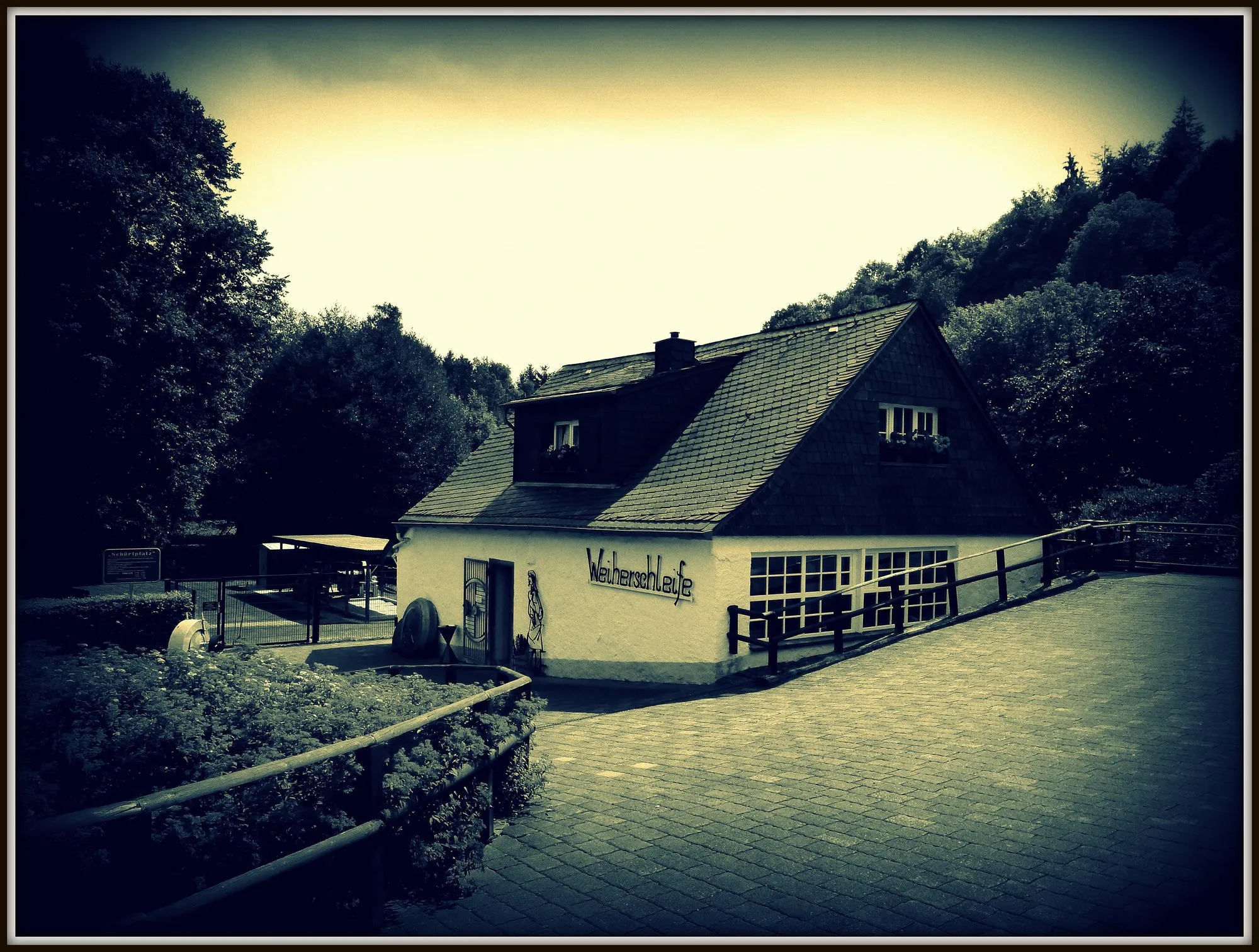
This is Idar-Oberstein, in Rhineland-Palatinate, Germany’s gem-cutting capital. The building is the Historische Weiherschleife, a water-powered cutting mill that ran from 1754 to 1945, which is to say it was working through exactly the period when these skulls were carved. The cutters lay face down on wooden benches over huge vertical sandstone wheels turned by the river.
This is where Boban had his skulls made, out of Brazilian quartz, in a faux-Aztec style. Not in a Maya workshop: in a German valley, to order.
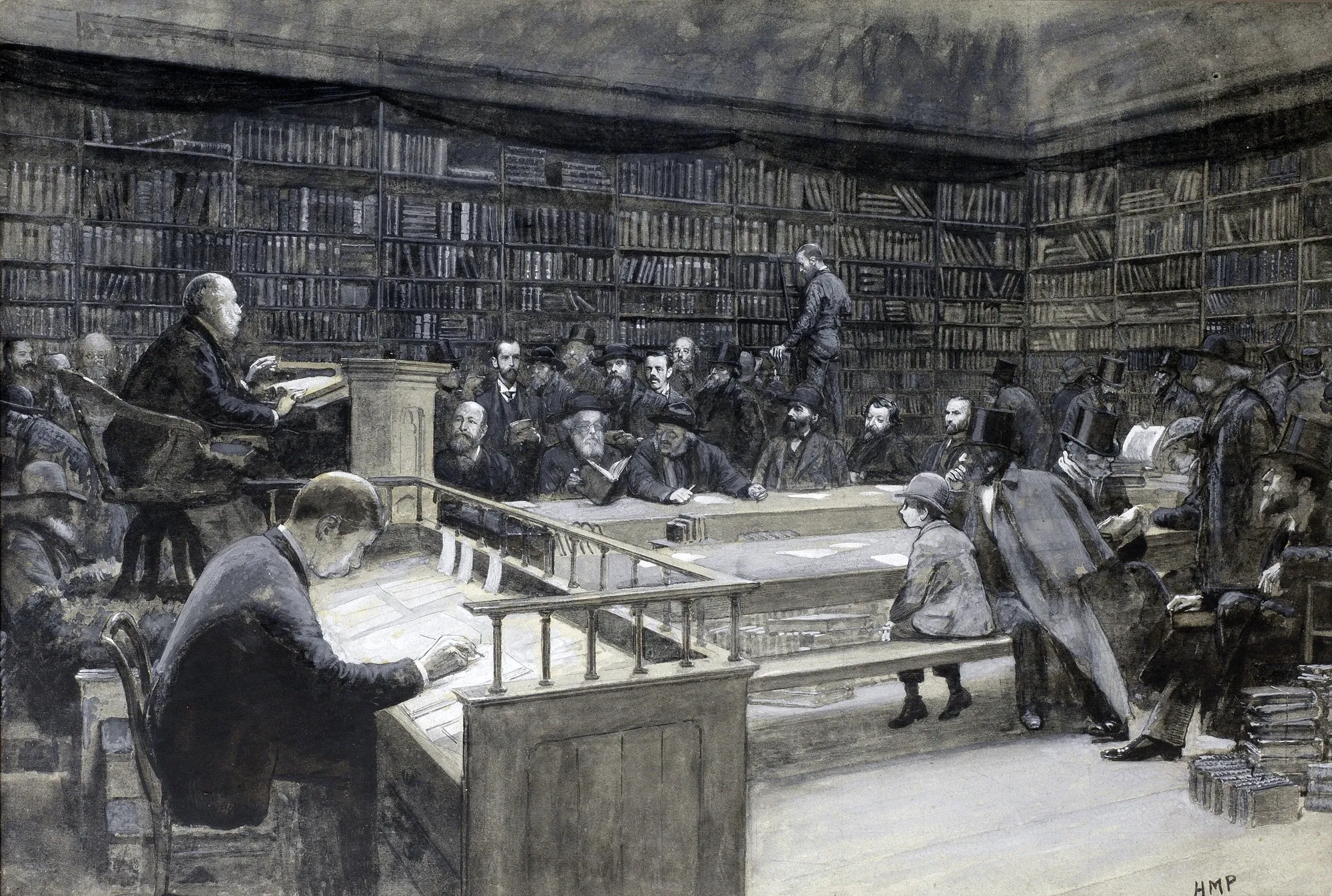
And here is the other end of the chain: a Sotheby’s saleroom, drawn in 1888. The auctioneer is at his rostrum, the clerk is writing, the buyers wait in top hats. Fifty-five years later, in the same house, at 34-35 New Bond Street, the skull went under the hammer as lot 54.
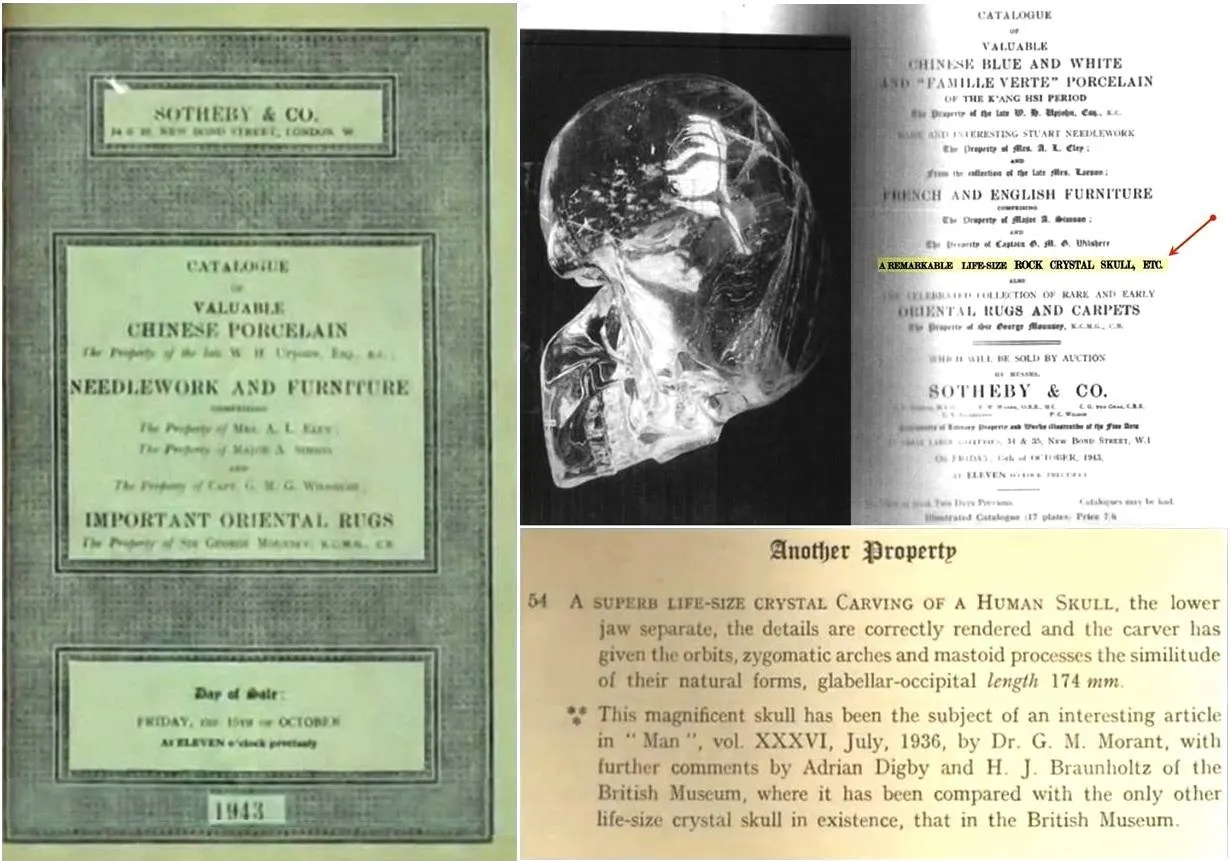
And here is the document itself. The cover announces “Catalogue of valuable Chinese porcelain, needlework and furniture […] important Oriental rugs”, with the date: Friday, the 15th of October, 1943, at eleven o’clock precisely. Inside, one highlighted line: “A remarkable life-size rock crystal skull, etc.” The most famous skull in the world went through between Chinese porcelain and Oriental carpets.
The lot 54 entry is clinically precise:
“A superb life-size crystal Carving of a Human Skull, the lower jaw separate, the details are correctly rendered and the carver has given the orbits, zygomatic arches and mastoid processes the similitude of their natural forms, glabellar-occipital length 174 mm. […] This magnificent skull has been the subject of an interesting article in “Man”, vol. XXXVI, July, 1936, by Dr. G. M. Morant, with further comments by Adrian Digby and H. J. Braunholtz of the British Museum, where it has been compared with the only other life-size crystal skull in existence, that in the British Museum.”
Read that last line again. In 1943, Sotheby’s states in print that this skull has no pre-Columbian story to tell, only a cousin in the British Museum. Not a word about Lubaantun, not a word about a girl, not a word about Honduras.
The three skulls, one at a time
The general timeline below mixes all three, because their paths cross. Here is each one on its own first: where it is first seen, where it came from, and where it is today.
💀 The Mitchell-Hedges skull
| Museum number | 🔴 none. No museum has ever owned it, so no record exists for it. It is the only one of the three in that situation, and that sums up the whole file |
|---|---|
| Made | in Europe, between 1900 and the early 1930s. No source names a workshop |
| What it is | ”a veritable copy” of the British Museum skull, in the Smithsonian’s words: almost exactly the same size and shape, with finer modelling of the eyes and teeth, and above all a separate mandible, which puts it in a class of its own |
| First known owner | Sidney Burney, a London art dealer, in 1933. The Smithsonian is blunt: there is no information about where he got it |
| 🔴 February 1933 | Burney tries to sell it to the American Museum of Natural History in New York, saying it came from Mexico. Not Belize. Not Lubaantun. Mexico. Eleven years before Mitchell-Hedges bought it, and twenty-one years before the jungle story |
| First study | 1936, in MAN: Dr. G. M. Morant and British Museum curator Adrian Digby compare the two skulls across a series of articles |
| Bought | 15 October 1943, at Sotheby’s, 34-35 New Bond Street, lot 54, for £400. The buyer is Mitchell-Hedges |
| After that | 1959 his death, Anna inherits · 1964 entrusted to Frank Dorland in California · 2007 Anna dies · 2008 her husband Bill Homann takes it to the Smithsonian for analysis |
| Today | 🔴 in private hands, with Bill Homann. It is the only one of the three no museum owns, and the only one you cannot go and see |
| The verdict | rotary diamond tools and modern synthetic lubricants under the electron microscope (Sax et al., 2008) |
⚠️ What it never had: an archaeological context. No excavation, no accession number, not one photograph before 1943. That is the whole difference with the 800 Roatán objects further down, which each have one.
🔴 And the forgery charge is not from 2008. It is from 1936. In the very first comparative study of the two skulls, someone wrote that this one was an improved copy of the British Museum skull, showing “a perverted ingenuity such as one would expect to find in a forger”. Adrian Digby dismissed it, because the microscopes of the day found no modern tool marks. It took seventy-two years and a scanning electron microscope to prove him wrong.
💀 The British Museum skull
| Museum number | Am1898,-.1, official title: “The Crystal Skull”. Public record |
|---|---|
| Made | the record dates the object “1881 (before)”, so before 1881 and no closer. The quartz itself is judged Brazilian, and the Brazilian sources have been worked only in modern times |
| First appearance | 1881, in Eugène Boban’s Paris shop. The museum’s own record names Boban as the collector. 21 cm, asking 3,500 francs, unsold. His own catalogue lists it apart from his Mexican antiquities and gives it no provenance at all |
| Sold as | Aztec, and exhibited in Mexico City in 1885 in his own Museo Científico as “the only piece of its kind in the world”, beside real human skulls. He tries to sell it to Mexico’s National Museum together with Leopoldo Batres, the official protector of pre-Hispanic monuments; the partnership sours and Batres denounces him as an antiquities smuggler. That is the lie, and it predates Anna’s story by sixty years |
| The chain, with the money | Dec. 1886, Boban’s New York auction through George A. Leavitt & Co.: Tiffany & Co. buys it for $950 · 1887, resold for $1,100 to George Sisson · a decade later Tiffany passes it to the British Museum for $950, its own purchase price |
| Bought | by the British Museum from Tiffany & Co., “in the late 1890s”. 🔴 The museum registers it in 1898, not 1897 as it is written everywhere. ⚠️ The record’s “G Sissin” is George Sisson, the 1887 owner |
| Its size | 25 cm high, 11.5 wide, 19 deep, about 4.5 kg. The same height as the Smithsonian skull and three times lighter |
| Analysed | by the museum’s own laboratory, then in 1996 by Margaret Sax. The lines of the teeth were judged to have been cut with a jeweller’s wheel, not by the techniques available to Aztec lapidaries |
| Today | ✅ at the British Museum, Africa, Oceania and the Americas department. 🔴 Not on display, in the record’s own words |
🔴 Watch out for the image trap. The Wikimedia Commons file called
MitchellHedgesCrystalSkull.jpg shows this skull, not the Mitchell-Hedges one. It illustrates
a dozen Wikipedias under the wrong name.
💀 The Smithsonian skull
| Made | in Mexico, and “probably shortly before it was sold”. The polishing technology used did not exist before the Second World War |
|---|---|
| Bought | in Mexico, in 1960, according to the donor, who stayed anonymous. The record’s place field reads, exactly: “Not Given, Mexico” |
| Arrived at the museum | 🔴 by mail, in 1992, sent anonymously to the Smithsonian with a letter claiming it came from the Aztec empire. The museum tells the story itself |
| Entered the registers | on 9 August 1996, the accession date on the record, thirty-six years after the purchase and four years after the parcel |
| Its size | 31 pounds, close to 10 inches. As measured by the museum: 25.5 cm high, 22.8 cm deep, about 14.1 kg, in white quartz. “It dwarfs all others”: by far the biggest of the three |
| Today | ✅ at the Smithsonian, National Museum of Natural History. Its record is public and its metadata is CC0: nmnhanthropology_8552155 |
| The verdict | written by anthropologist Jane MacLaren Walsh in 2008, on the museum’s own record |
⚠️ One distinction that matters: the Smithsonian skull is the only one of the three whose museum record says it is modern, in plain words, on the object’s public page.
The three of them in one line
| First seen | Came from | Where it is today | |
|---|---|---|---|
| Mitchell-Hedges | 1933, with a London dealer | acquired at Sotheby’s, 1943 | 🔴 private collection, unseen |
| British Museum | 1881, Boban’s shop | bought from Tiffany, 1898 | ✅ London, but not on display |
| Smithsonian | 1960, in Mexico | arrived by mail in 1992, anonymous | ✅ Washington, public record |
Not one of the three came out of an excavation. That is what unites them, and the British Museum says it for the whole category: no crystal skull has ever been found at a documented archaeological dig.
Timeline
| Date | What happens | Source |
|---|---|---|
| 1754-1945 | The Weiherschleife at Idar-Oberstein cuts gemstones by water power | Historic site notice, Idar-Oberstein |
| c. 1860 | Eugène Boban, a French dealer, sets up in Mexico | Le Lab Secret S04EP09, 1:00:34 |
| 1881 | The future British Museum skull is in his Paris shop | British Museum, record Am1898,-.1 |
| 1885 | He exhibits it in Mexico City as Aztec | British Museum, record Am1898,-.1 |
| 1898 | Tiffany & Co. sells it to the British Museum | British Museum, record Am1898,-.1 |
| 1903 | Dr. Thomas Gann finds Lubaantun | Le Lab Secret S04EP09 · Jackalope #55 |
| 1915 | Harvard archaeologists survey the site | Jackalope #55, 12:07 |
| 1917-1918 | Mitchell-Hedges takes in, then adopts, Anna | Myth Hunters, 07:05 · Jackalope #55 |
| 1921 | Affair with Lady Richmond Brown, who will fund everything | Myth Hunters, 03:15 · Jackalope #55 |
| 1922 | Start of six expeditions to Panama, among the San Blas Cuna | NMAI, record NMAI.AC.001_ref15761 |
| 1900 → early 1930s | Probable manufacture of the Mitchell-Hedges skull, in Europe | Sax et al., 2008 · BBC Travel, 2012 |
| 1924 | Gann digs Lubaantun. Mitchell-Hedges and Lady Brown accompany him | NMAI, record NMAI.AC.001_ref15761 |
| 1 January 1924 | The date Anna will give: her 17th birthday, the skull down a shaft | Anna Mitchell-Hedges, as related on Le Lab Secret S04EP09 |
| 1927 | British Honduras bans the removal of cultural artefacts | Jackalope #55, 13:46 |
| 1929-1936 | He moves his operations to the Bay Islands | Expedition Unknown, Bill Homann · NMAI records |
| 1932 | He donates material from Isla Roatán to the Museum of the American Indian | Smithsonian, record NMAI_195563 |
| 1933 | The skull belongs to Sidney Burney, shown in a London gallery | Jackalope #55 |
| February 1933 | 🔴 Burney tries to sell it to the American Museum of Natural History, saying it comes from Mexico | Smithsonian, Walsh |
| July 1936 | MAN, vol. XXXVI, Dr. G. M. Morant: the first certain description | Sotheby’s catalogue, 15 Oct. 1943, lot 54 |
| 15 October 1943 | Sotheby’s, lot 54, 34-35 New Bond Street, £400 | Sotheby’s catalogue, 15 Oct. 1943 |
| December 1943 | Letter to his brother: “I bought the magnificent skull” | Le Lab Secret S04EP09, 57:07 |
| c. 1950 | He finally begins exhibiting it | Jackalope #55 |
| 1954 | Danger, My Ally: thirteen lines, and a refusal to explain | F. A. Mitchell-Hedges, Danger, My Ally, 1954 |
| 1959 | His death. Anna inherits, and invents the discovery | Jackalope #55 |
| 1964 | She entrusts the skull to Frank Dorland, in California | Jackalope #55 |
| 1996 | Margaret Sax tests several skulls at the British Museum | Sax et al., J. Archaeol. Sci. 35(10), 2008 |
| 2007 | Anna dies | Le Lab Secret S04EP09, 58:36 |
| 2008 | Bill Homann takes it to the Smithsonian. Rotary diamond tools and modern lubricants | Sax et al., J. Archaeol. Sci. 35(10): 2751-2760 |
The real find: what he pulled out of the Bay Islands
Here is where the story stops being about a hoax.
Between roughly 1929 and 1936, Mitchell-Hedges moved his operations out of the mainland and Belize and into the Bay Islands of Honduras. He worked from a 25-ton motor yacht, the Amigo, with a base camp on a small cay inside Old Port Royal. And he dug, on Roatán, on Santa Helena, on Barbareta, on Guanaja.
He was chasing a pre-Maya civilisation, and he was convinced the Bay Islands would prove it was advanced. In the process he turned up genuine pre-Columbian relics, and we can now say how many.
Eight hundred. Counted on 18 September 2026 in the Smithsonian’s own search engine: his name returns 1,113 collection records, every one of them at the National Museum of the American Indian, and the place filter puts 800 of them in the Bay Islands. They break down like this:
| Place | Records |
|---|---|
| Bay Islands, all islands together | 800 |
| José Santos Guardiola Municipality, the east end of Roatán | 560 |
| Isla Barbareta | 284 |
| Isla Santa Elena, including 97 out of its caves | 228 |
| Isla de Guanaja | 153 |
| Isla Morat | 48 |
| Isla Roatán, under that exact name | 38 |
| outside the archipelago: Panama | 313 |
⚠️ These are records, not objects: one record can hold several sherds, and an object with no photograph never shows up. So the number is a floor, not a total. It also settles a rumour: the “over 3,000 pieces” that circulates in the retellings has no source at all.
George G. Heye, director of the Museum of the American Indian, wrote that the find was “one of the most important in a decade in Central America.”
And you can check it yourself in a minute. The Smithsonian’s collection records list Mitchell-Hedges as collector, previous owner and donor, and the place field reads Isla Roatán, Islas de la Bahía, Honduras. One record taken at random: a tripod vessel fragment, NMAI_195563 “collected or excavated by explorer and adventurer Frederick A. Mitchell-Hedges, probably between 1930 and 1932; donated to MAI by F. A. Mitchell-Hedges in 1932.”
Three records, three islands, three years
Picked at random out of the 800, and read in full on 18 September 2026. Each one carries its number, its island, its material and the year he gave it to the museum.
| Object | Island | Material | Donated | Record |
|---|---|---|---|---|
| Tripod vessel fragment | Isla Roatán | pottery, modelled, perforated, punctate | 1932 | NMAI_195563 |
| Woodworking celt | Isla de Guanaja (Bonacca) | ground stone | 1931 | NMAI_192739 |
| Pendant | Isla Morat | greenstone, incised, ground, drilled | 1935 | NMAI_200720 |
All three say the same thing, word for word: collector, previous owner, donor = Frederick A. Mitchell-Hedges. And all three say “donated”. Not sold. It is the one point on which the man never contradicted himself.
⚠️ Why there is no photo gallery here. The records are CC0, the photographs are not. Every National Museum of the American Indian record carries “Usage Conditions Apply”, and in plain words: “there are restrictions for re-using this media.” Checked on three records out of three, on 18 September 2026. So we give the links, and the photographs stay where they live, where anyone can look at them for free.
👉 Search the Smithsonian records yourself Ceramics, stone tools, figure fragments, most images released under CC0. The “Place” panel on the left gives the island-by-island breakdown in the table above.
That is the difference between the two halves of this man. The skull has no paperwork. The Roatán material has accession numbers.
Why he came here at all
Three dates, each documented separately.
| 1927 | British Honduras passes laws blocking the removal of cultural artefacts, in part a response to the looting of Lubaantun, where the party had gone as far as dynamiting the top off a stepped pyramid |
|---|---|
| 1929 | Mitchell-Hedges moves his field operations into the Bay Islands of Honduras |
| 1932 | He donates Roatán material to the Museum of the American Indian in New York |
⚖️ The causal link is my reading, not a quote from anyone. But the door that closed in Belize and the door that opened in Honduras are two years apart, and he wrecked the first one himself.
Port Royal, Fort Frederick and the cannon
Old Port Royal, on Roatán’s south shore, was an English buccaneer stronghold in the 17th and 18th centuries. Edward “Ned” Low worked out of here, and so, by reputation, did Henry Morgan, whose name a beach resort carries today, which is why searching for the pirate now mostly gets you a hotel.
Mitchell-Hedges mapped the ramparts, the earthworks and the gun emplacements of Fort Frederick. Unglamorous work, and the sort that holds up.
Bailey Cay and the four chests: a story he told
⚠️ First, a name that trips everyone. There are two “Baileys” on Roatán. Bailey’s Key is in Sandy Bay on the northwest coast, where Anthony’s Key Resort sits. Bailey Cay is inside Old Port Royal, on the south shore. The treasure story belongs to the second. Nearly every retelling online mixes them up.
Now the story, and it is a story.
He wrote in Danger, My Ally that a compass spun wildly over the sand at Bailey Cay, that trenching turned up two iron-bound chests of Spanish silver and gold, and that two more followed, full of church plate and uncut gems. He wrote that the authorities in Coxen Hole took an interest, that he sailed 150 miles offshore, repacked everything in crates stencilled “Maya Artifacts”, and cleared customs. Port Royal families still say a chest was reburied and never found.
No record supports any of it. No museum accession, no numismatic trail, no manifest. The indigenous objects he handled are catalogued. The gold is not.
That is not the same as calling him a liar. It is saying that we know how to check one of these claims and not the other, and only one of them passes.
The Santa Helena caves and the Atlantis claim
Santa Helena, separated from eastern Roatán by a mangrove channel, is limestone honeycombed with caverns. Mitchell-Hedges pulled funerary urns, incense burners and carved stone out of them and concluded that the Bay Islands were the mountaintops of Atlantis, and the artefacts the work of a lost pre-flood civilisation.
The Smithsonian archaeologist William Duncan Strong surveyed the same sites in the mid-1930s and found something less thrilling and far more interesting: genuine pre-Columbian material from real cultures with real trade links to the mainland. No sunken continent required.
✅ And his report exists, it is public, and you can read it. Archaeological Investigations in the Bay Islands, Spanish Honduras, Smithsonian Miscellaneous Collections, vol. 92, no. 14, Washington, 1935: 176 pages, 33 plates, 38 figures, free to read at the Smithsonian repository. It is the systematic inventory of the deposits, graves and caves of Roatán, Santa Helena, Barbareta and Guanaja, published the very year Mitchell-Hedges left the archipelago.
That is the difference between the two men, in one document: one told an Atlantis story in a popular book, the other described the same islands in a museum publication anyone can still open ninety years later.
What is still there today
Port Royal is still there. Fort Frederick’s ramparts are still in the bush. Cow and Calf still mark the reef passage, exactly as they did when the Amigo used them as a transit. Santa Helena’s cliffs still have their caves.
None of that is a ticketed attraction, and I am not going to pretend otherwise. But the island reads differently once you know that the man who sold the world a fake crystal skull left his real work in a museum catalogue with Isla Roatán in the place field, and that the culture he found here, as one television host put it after coming to look for himself, is still largely forgotten.
The skull is a fake. What he really took out of Roatán is at the Smithsonian. And we go right past it on our tour.
If you want to see the south shore for yourself, that part I do run. The Pigeon Cay trip is the one that follows his tracks most closely: it starts at Fort Morgan Cay, it snorkels inside Old Port Royal, and it runs past the reef passage and the cays Mitchell-Hedges names in his book. Bailey Cay and its four chests sit in that same stretch of water. You will not dig anything up, but you will see exactly what he saw from the Amigo.
Otherwise, the island webcams if you are still deciding.
Sources
- Smithsonian collection records : the Mitchell-Hedges material from Roatán, most images CC0
- Expedition Unknown : Josh Gates tests the skull, with Bill Homann, the Heye letter and the lantern slides of the Bay Islands
- Le Lab Secret, S04EP09 : La vraie histoire des crânes de cristal, hosted by Christian Page, who met Anna in person. The most thorough French-language account of the hoax
- The Ancient and Esoteric Order of the Jackalope, #55 : Lost Legacy, on Lubaantun, the passport records and the 1927 antiquities law
- Myth Hunters : The Legend Of The Ancient Crystal Skulls
- Sax, M., Walsh, J. M., Freestone, I. C., Rankin, A. H. & Meeks, N. D. (2008), “The origins of two purportedly pre-Columbian Mexican crystal skulls”, Journal of Archaeological Science, 35(10): 2751-2760, the peer-reviewed study
- Jane MacLaren Walsh, “Legend of the Crystal Skulls”, Archaeology, 61(3): 36-41, 2008
- Smithsonian, National Museum of Natural History, Ancient Mexico, Hollywood and the French Connection, by Jane MacLaren Walsh: the crystal skulls research pages, archived. The full genealogy of the four generations of skulls, the Boban-Leavitt-Tiffany-Sisson-British Museum chain with its prices, and Burney’s attempt to sell to the AMNH in February 1933
- Digby, A. (1936), Man, vol. XXXVI, p. 108: the British Museum curator dismisses the copy hypothesis, for want of tool marks visible to the microscopes of his day
- The British Museum skull’s official record:
Am1898,-.1, with Jones’s (1990) curator comment, the dimensions, and the words “Not on display” - Jones, M. (ed., 1990), Fake? The Art of Deception, British Museum, catalogue no. 328. 🔴 The museum showed its own skull in its exhibition about fakes
- Sax, M. & Meeks, N. D. (2009), The manufacture of a small crystal skull purported to be from Ancient Mexico, cited by the museum’s record (pp. 47 and 54)
- Jane MacLaren Walsh & Brett Topping (2019), The Man Who Invented Aztec Crystal Skulls: The Adventures of Eugène Boban, Berghahn Books, New York and Oxford. A whole book on the dealer where it all starts, cited by the Smithsonian on its own object record
- The Smithsonian skull’s official record:
nmnhanthropology_8552155, carrying the note signed by Jane MacLaren Walsh, the accession date of 9 August 1996 and the museum’s measurements - W. D. Strong (1935), Archaeological Investigations in the Bay Islands, Spanish Honduras, Smithsonian Miscellaneous Collections, vol. 92, no. 14, 176 pp., 33 plates. The reference archaeological survey of Roatán, Santa Helena, Barbareta and Guanaja, free to read
- National Museum of the American Indian archives : the Mitchell-Hedges biographical record, in the Heye Foundation papers
- BBC Travel, Alex von Tunzelmann : The kingdom of the crystal skull, 2012, reported from Lubaantun
- F. A. Mitchell-Hedges, Danger, My Ally, 1954 : his own account, and the source of the treasure story
Frequently asked questions
Is the Mitchell-Hedges crystal skull real?
No. Electron microscopy at the Smithsonian found marks left by modern rotary diamond tools and synthetic lubricants. The skull has no archaeological context of any kind: it first appears in print in 1936, owned by a London dealer, and Mitchell-Hedges acquired it in 1943.
Did Anna Mitchell-Hedges find the skull at Lubaantun in 1924?
The records say she was not even there. Thomas Gann's 1924 expedition report names Mitchell-Hedges, Lady Richmond Brown and her monkey Michael, but not Anna. Passport records indicate her first trip to Central America came in the 1930s. And no photograph of Anna or her father with the skull exists before 1943.
Did Mitchell-Hedges really dig on Roatán?
Yes, and that part is documented. The Smithsonian's own catalogue lists him as collector and donor of material from Isla Roatán, donated to the Museum of the American Indian in 1932. You can search the records yourself.
Is there pirate treasure buried on Roatán?
Mitchell-Hedges wrote in his 1954 memoir that he dug four iron-bound chests out of Bailey Cay, in Old Port Royal. No museum accession and no numismatic record supports it. Treat it as a story he told, because that is what it is.
Who actually made the crystal skulls?
European lapidaries. The trail runs back to Eugène Boban, a French dealer in Mexico around 1860, who had skulls carved in Idar-Oberstein, Germany, from Brazilian quartz and sold them as Aztec. Boban did not invent the object, Maya artisans were already carving small quartz skulls as tourist trinkets. He invented their age.