Honduras Gangs: The 2026 Laws Explained, and What They Mean for Visitors
Honduras has a gang problem, and in 2026 it answered with the law: three anti-gang laws in six months. The latest one includes a rule that is getting a lot of attention, Casa Segura (“safe home”).
I have lived on Roatán since 2014, and I guide visitors here in English, French and Spanish. I went to the official sources, the National Congress and the official gazette La Gaceta, to sort out what is actually in force, what is not yet, and what it changes for you.
Honduras gangs: the short answer
The gangs, called maras and pandillas in Honduras (MS-13 is the best-known), are exactly what the new laws go after. They do not shape every corner of the country in the same way, and the risk for a visitor depends a lot on where you go.
Before you travel:
- Read your government’s travel advice. US visitors: the State Department’s Honduras travel advisory. Canadians: travel.gc.ca.
- For Roatán specifically, I give you a local’s honest answer in Is Roatán safe?
Three laws in six months: the timeline
| Date | What happened | Status |
|---|---|---|
| 22 May 2026 | Penal Code reforms: the maras and pandillas become terrorist associations, extortion sentences go up, and a National Anti-Crime Agency is created. | In force |
| 26 September 2026 | Decree No. 208-2026 (La Gaceta No. 37,256): gang members held in maximum-security isolation, no-contact visits, no communication devices, 30 minutes of exercise a day. Passed unanimously on 22 September. | In force |
| 27 October 2026 | A new law “to strengthen the criminal and procedural framework” against gangs, passed by 119 members of Congress. It includes Casa Segura. | Passed, not yet published |
What the 27 October law says
According to the text published by the National Congress:
- terrorism sentences go from 15-20 years to 30-40 years;
- life in prison for gang leaders and for anyone who recruits minors;
- no parole for people convicted of terrorism;
- prosecutors get 48 hours (instead of 24) to file charges after an arrest;
- searches during coordinated operations between agencies;
- gang graffiti and symbols are erased from neighbourhoods;
- penalties for attacks on police, soldiers and justice officials.
Honduras’s Supreme Court had sent its opinion on the bill to Congress on 20 October.
Casa Segura: self-defence presumed at home
This is the part everyone is talking about. Casa Segura adds a sixth case to article 30 of the Penal Code, the list of grounds that clear a person of criminal responsibility.
In plain words: if someone breaks illegally or violently into your home, business, farm or an occupied vehicle, and threatens the life, safety, freedom or property of the people inside, the law presumes that whoever defends themselves acted in self-defence.
It is not a licence to shoot. The presumption falls if there is objective evidence of an execution, revenge, a staged scene or disproportionate force.
⚠️ It is not confirmed in force yet. In Honduras a law takes effect once it is published in La Gaceta. On 2 November 2026 I checked the official register: it stops at the 26 October issue, and this law is not there. The Diario Nacional de Honduras, the state news outlet, also says to wait for that publication. I will update this post when it appears.
Is Honduras copying Bukele’s El Salvador?
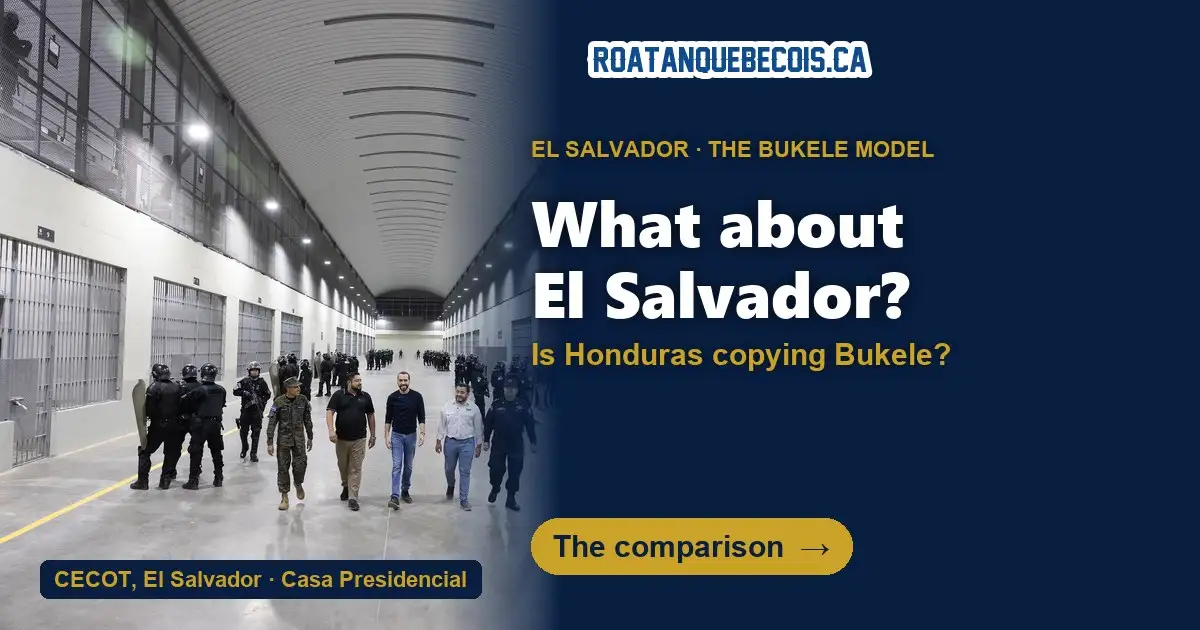
People ask me this since neighbouring El Salvador built CECOT, its mega-prison. The short answer: same target, opposite method.
| Honduras | El Salvador | |
|---|---|---|
| State of exception | Ended on 26 January 2026, after more than three years | Extended for the 56th time on 21 October 2026, in place since March 2022 |
| Method in 2026 | Laws passed by Congress (the three laws above) | Constitutional rights suspended, renewed month after month |
| Arrests | No comparable figure published | More than 93,000, nearly 90% held without trial, according to prosecutors |
| Deaths in custody | No comparable figure published | At least 454, according to the rights group Cristosal before the IACHR |
In El Salvador, Nayib Bukele’s state of exception drove crime down to historic lows, which is why it is popular across the region. The cost is the arrests without trial and the deaths in prison that human rights groups denounce.
Honduras lived under a partial state of exception from December 2022 to January 2026. It has left it, and now works through laws that are passed, published and open to challenge in court. The longer sentences and maximum-security isolation look like the Salvadoran model, but the mechanism is a Congress, not an emergency measure.
Is Honduras safe, then? It depends on where you go, and for the island I answer that in detail in Is Roatán safe?
Sources: El Salvador’s Legislative Assembly on the 56th extension, France 24 (AFP) on the IACHR hearing, NODAL on the end of Honduras’s state of exception (in Spanish).
What it changes for you, on holiday in Roatán
Nothing in your day. These laws target three things: gangs, prisons, and people defending their own homes. Your arrival at the airport, your tours, your dives on the reef: all the same as before.
You still need to fill in the online entry form before your flight, which I walk through in the Honduras entry form guide. And if you are flying from the UK, there is better news this week: Honduras has dropped the visa for British citizens.
The official sources
Everything here comes from these pages, checked on 2 November 2026:
- The National Congress of Honduras, on the reforms in force since 22 May, on Decree 208-2026 and on the 27 October law (in Spanish).
- The official La Gaceta register (Empresa Nacional de Artes Gráficas), where Decree 208-2026 appears in La Gaceta No. 37,256.
- Diario Nacional de Honduras, the state news outlet, on what Casa Segura protects (in Spanish).
This post explains the laws; it is not legal advice.
Planning the trip? Browse our Roatán tours, and message me with any question, in English, French or Spanish. See you on the island.
Frequently asked questions
What are the new gang laws in Honduras?
Three laws in 2026. Since 22 May, the maras and pandillas (street gangs) are legally terrorist associations. Since 26 September, Decree 208-2026 puts gang members in maximum-security isolation. On 27 October, Congress passed a law raising terrorism sentences to 30 to 40 years, with life for gang leaders, and including the Casa Segura self-defence rule.
What is the Casa Segura law in Honduras?
An addition to article 30 of the Honduran Penal Code. Self-defence is presumed when someone breaks illegally or violently into a home, business, farm or occupied vehicle and threatens the life, safety, freedom or property of the people inside. The presumption falls if there is evidence of an execution, revenge, a staged scene or disproportionate force.
Is the Casa Segura law in force?
Not confirmed yet. The National Congress passed it on 27 October 2026, but on 2 November 2026 it did not appear in the official register of La Gaceta, Honduras's official gazette. A Honduran law takes effect when it is published there.
Do these laws change anything for a tourist in Roatán?
No, not in your day. They target gangs, prisons and residents' self-defence. Your arrival, your tours and your stay on the island are the same as before.